

Follow our group of Kiwis as they journey through the South Caucasus; exploring the rich history, warm hospitality and breathtaking landscapes of Georgia, Armenia and Azerbaijan. From ancient monasteries and dramatic mountain passes to colourful markets and vibrant cities, this region delivers unforgettable moments at every turn.
Map:

Day 1: Auckland to Dubai - Mon 28 September | We’re off!
A very enthusiastic and organised group gathered at Auckland Airport — you know the tour is off to a good start when everyone arrives early and check‑in runs smoothly. Once everyone had their two boarding passes, the Economy and Premium Economy travellers met for a coffee, while those in Business Class enjoyed their lounge.
Thankfully, the plane wasn’t full and most of us had room to spread out.

Day 2: Dubai to Baku - Tue 29 September | Making a Connection
Once on the plane to Baku, we settled in for the four‑hour flight through the safe corridor. Night fell quickly, with a clear, bright moon dominating the black sky. Below, scattered towns and oil flares glowed in the darkness.

And just like that, we were in Baku — greeted by an extremely smooth passport control and then that anxious wait to see if all the bags had made it. Thankfully, yes… clothes for tomorrow!

Toghrul Baghirli, our Azerbaijan guide, was waiting for us, and in no time we were at our hotel and finally getting some well‑earned sleep.
Day 3: Baku - Wed 30 September | F1 was here


We did pay attention as Toghrul walked us through the history, especially Imperial Russia’s influence and then the USSR’s role. It’s fair to say that anyone who invaded anywhere seemed to have a go at Azerbaijan at some point.

Walking through the streets to Maiden Tower, the oldest and most original part of Baku, none of us felt inspired to climb it, so we opted instead for a cooling stroll along the Boulevard by the Caspian Sea. Our walk continued to Fountain Square, lined with cafes and boutiques. Everyone enjoyed some free time for a small lunch, coffee, or a snack.


Back together again, we took the bus to the hotel for a well‑earned break.
At 4pm, Mandy trotted us across to the mall for snacks and beverages. At 5pm we had our first social drink in her room, and once again this happy group found plenty to talk about.
Later we ventured out into the traffic (and it was bumper to bumper) to get to our restaurant, Shirvanshah. This astounding place was once a hamam (bath house) and has been converted into a spacious restaurant with ornate curtains, carpets, mirrors, and private rooms. Very impressive. Driving back through quieter streets, the neon light displays on the skyscrapers were something else — particularly the Flame Towers.
Day 4: Baku - Thu 1 October | Ring of Fire
Today was the day for Zoroastrianism, the oldest monotheism, and their great love of fire. Azerbaijan was home to many Zoroastrians until they were exiled or killed by Ottomans and Russians. As Baku sits on natural gas and oil fields, there were once many temples where the fire could continually burn. Just outside the town centre is Ateshgah, an ordinary-looking neighbourhood with houses, gas pipes and shops — and at the end of a normal road sits this ancient complex. Yes, it’s been reconstructed, but it still feels old. Around the central altar is a caravanserai converted into a museum. Those Zoroastrians were a strange lot who seemed to enjoy torturing their bodies.


Moving on to Ramana Fortress, we passed acres of old oil rigs still nodding away. We saw old photos showing that much of Baku was once covered in them. Ramana is a mediaeval tower built of stone and limestone bricks, standing on the highest point. Once part of a defence chain, it now sits atop a neighbourhood. Recently converted into a museum, the tower allows visitors to climb four floors to the roof and look back toward central Baku and the surrounding area. Home to 3 million people, Baku is expanding, and old fields are becoming suburbs.


Our last stop for the morning was the Heydar Aliyev Cultural Centre — an enormous white building designed by Zaha Hadid that seems to drape and fold. Inside, it’s just as amazing, with smooth white curved walls and ceilings. Full of art and displays, you could easily spend a day there. We explored the most interesting pieces until it was time to leave.


Lunch was needed to refill our batteries.
Our final visit was Villa Petrolea, the Nobel Brothers Museum. This private museum was all ours to explore with Toghrul. Once the home of the Nobel Brothers, it has been lovingly restored, and many of their possessions have been returned. Built in the Russian Imperial style, the house reflects the Nobels’ Saint Petersburg connections. Around the house was once Black City — the factories and refineries of the Nobels; today it has been replaced with White City, full of expensive apartments.


Waiting for us on the back terrace was caviar and brut, so for 15 minutes we lived in the style of the very rich. The sun came out to shine on us, the garden, and the peace of this private place.
Back in the traffic, we had time to return to the hotel before dinner. Tonight’s restaurant was Finuza, an ethnic restaurant packed full of eager diners. Our stomachs are expanding to accommodate the usual small salad starter, soup, main course and dessert with tea. I doubt anyone will lose weight on this trip.
Day 5: Baku - Fri 2 October | Old and New
Clouds were heavy today and the temperature had dropped; rain was forecast but hadn’t arrived yet.
The first site we drove to, south of the city, was Gobustan. In the 1950s, quarry workers found rock carvings as they were dynamiting. Fortunately, these carvings — and others found on two nearby hills — have been preserved. The ones at Gobustan are open to the public, but because they’re exposed to the weather they are known to be degrading and will eventually disappear. Even today, after decades of water and wind damage, we could still make out the animals and human shapes. Some are cracked or missing parts, but enough remains to show what humans were carving 40,000 years ago.


 High on the rock escarpment we had views to the Caspian Sea and distant old rigs — old and new together. Toto took us to the most distinct images, and then we returned to the museum area with its modern displays of the carvings, artifacts, and cave‑living exhibits.
Back on the bus, we drove to Baku through the refinery and service areas that support the massive oil industry here.
Lunch at La Quzu in the old town was most welcome, and once again we ate our way through three courses.
After lunch, the bus took us to the top of Martyr’s Lane and its sweeping view across the city. This area is also home to the three Flame Towers, which dominate the skyline above the old town. Up close, we could see the LED panels that create the flame effect at night — Azerbaijan, the land of fire. Martyr’s Lane is a memorial site and Muslim graveyard. Along a simple path are the graves of the 137 people killed during Black January in 1990. They were civilians fired upon by Soviet tanks and soldiers when Azerbaijani citizens were protesting for freedom from the USSR.


To us, the quiet lane with its black grave markers was deeply affecting. As we walked to the eternal flame and viewpoint, the wind began to rise and the clouds grew darker. We managed to get down the hill and back to our hotel before the rain arrived.
At 5pm, many of us met Mandy to find a simple meal before packing, as we leave Baku tomorrow to travel inland to Sheki. During the night there was a thunderstorm and plenty of rain.
Day 6: Baku to Sheki - Sat 3 October | Travelling Day
Starting earlier at 8am, we headed out of the city northwest toward Sheki, 293 km away. The first part of the journey was on a multi‑lane highway until we reached barren rolling hills with no trees. Cows randomly roamed about, occasionally crossing the highway. The temperature had dropped to 12°C and persistent rain followed us.
Toto patiently answered our many questions — everything from housing to government to food. Mandy helped us complete a cryptic crossword, and we listened to a murder mystery as the landscape slowly changed.
About three hours into the trip, while passing through vineyard country, we stopped at Shemakha and Juma Mosque. This Friday Mosque is the oldest in Azerbaijan and has been lovingly maintained and enlarged. Inside, gentle shades of green, chandeliers, and colourful mosaics created a peaceful atmosphere. Toto explained aspects of Muslim life, religious practices, and the differences between Sunni and Shia (Azerbaijan is mainly Shia). He also noted the strong tolerance in Azerbaijan toward all people, especially “people of the book” — Muslims, Jews, and Christians.


Further down the road, at a junction, we transferred to a mini‑van to reach the copper‑smith village of Lahij. The mountain road wound upward for 30 minutes, starting with smooth tarseal before narrowing and becoming more adventurous as the driver navigated fallen rocks and a tormented river rushing through a gorge. Rain had swollen the water level, and the brown current hurled itself against boulders and sharp bends.
Arriving in the village — still in the rain — Toto arranged an ex‑Soviet army vehicle to take us up the stone‑lined street to a mountain home for lunch. Bouncing around in the back and inhaling diesel fumes, we were all grateful to climb out and breathe fresh mountain air.


Our hosts, a grandmother and her daughter, were former carpet weavers who now supplemented their income by welcoming occasional foreign visitors. We were their first New Zealanders, and they were delighted. Through a metal door in a stone wall, we entered a simple compound with a wooden house, vegetable garden, fruit trees, a separate toilet, and a wood shed. Lunch was tomato and cucumber, homemade cherry juice, chicken with rice, homemade cookies, and tea.

Toto helped the daughter in the kitchen. She spoke some English and teased him: “I thought you said they spoke English.” “They do,” said Toto. “No they don’t,” she replied. “I can’t understand a word they say.”
After lunch, the grandmother and daughter joined us for tea, chatting via Toto mostly about recipes and food preparation. Before leaving, they proudly showed us a carpet they had woven and their hand‑cranked Singer sewing machine. A simple life.

Back into the Soviet transport, we returned to the village to visit the oldest coppersmith family. For 300 years the family has been making copper goods — and their workshop certainly looked the part.

 Finally, we walked down the stone‑and‑boulder‑lined street to our transit van, then back along the road (where more rocks had fallen) to our waiting bus. In winter, the village is isolated for months and relies on a bulldozer to clear snow and stones.
Travelling on, we reached Sheki around 6pm, went to dinner, and then checked into our five‑star hotel 5 km out of town. Day done, time for sleep.
Day 7: Sheki - Sun 4 October | Shake a leg in Sheki
We woke to clear skies and snow on the nearest mountain; still a cold 6°C, though the day was set to warm up. Driving down into the village, we passed packs of feral dogs; very glad to be in a big bus. In the main street, Ladas and old trucks lined the kerbs. Older people dressed in layers of dull clothes, with caps or scarves, carrying large plastic bags, entered and left the market.
Firstly, we passed fresh produce arranged in pyramids; pomegranates, tomatoes and cabbages making a colourful display. Further in, the narrow alley tight with stalls, people, and men pushing barrows, were trays of baklava, clothes, nuts and potatoes. Occasionally someone would speak or smile, giving us a flash of metal or gold teeth. Sheki is known for its sweets and its dentists!


On we went to the old part of town and specifically the Khan’s Palace. This complex is set behind the old city walls – amazing they still remain. Walking downhill, our first stop was the palace itself with its 500‑hundred‑year‑old plane trees. Looking out across the valley, the palace is not large but perfectly formed. Imperial Russia caused a lot of interior damage, and many original artefacts such as the silk carpets are missing, presumed in The Hermitage in St Petersburg. Later the Soviets helped with some restoration, and much later the Azerbaijanis. The structure has multiple intricate stained‑glass windows in geometric shapes, made like a jigsaw with interlocking pieces and not a single nail. We were there mid‑morning and the light splashed bright red and yellow across the walls and floor; at sunset the windows create a carpet of colour.


Inside the palace, there are six rooms across and two deep; all the formal rooms are richly painted with flowers, mythical creatures, whirls and vases. When the silk carpets were in place, their patterns reflected the ceiling above – each space would have been a jewel box of texture, pattern and colour.


Leaving the palace, we continued downhill to the carpentry shops where the stained‑glass windows are still made. The master craftsman demonstrated taking a corner apart and then putting it back together, each piece needed to make the pattern and keep the window strong.


Finally, we descended the street to one of the two remaining caravanserais in Sheki; the others were destroyed by the Soviets when Sheki resisted. This huge stone‑brick structure was built around a central courtyard with many small rooms facing inward. Safe from attack from the outside, but not very comfortable by today’s standards.


Free time for shopping gave the local economy a boost from us. Lunch was at a small family restaurant where we sat on the second‑floor veranda to catch the breeze and open air. Plov for us — delicious.
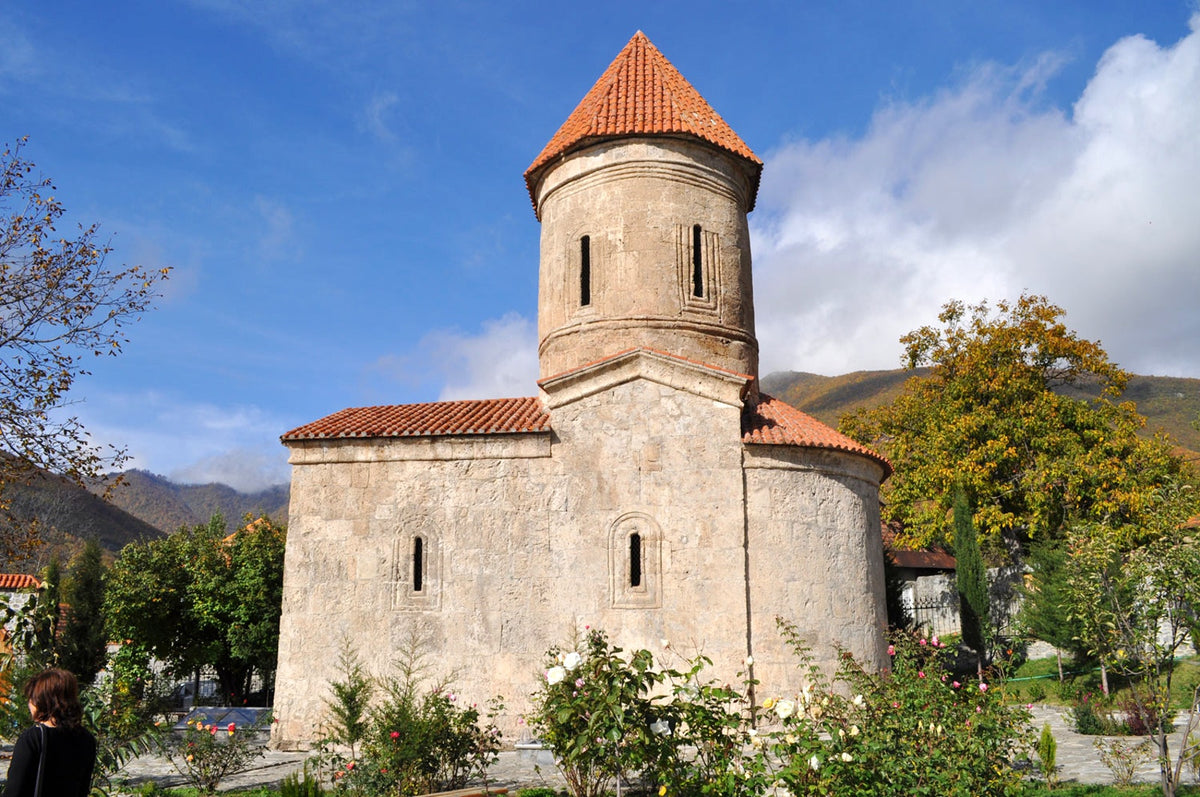
A short ride took us to the junction of Kish village. Here the road is too narrow and winding, so we switched to Lada taxis for a bumpy ride up the hill. In this small village lives an entrepreneurial woman who runs a café/guest house, makes baklava, offers a taxi service, and probably a few other things as well. Her family, though Muslim, had been looking after Kish Church for generations. Recently the church was made into a museum with an entry fee.


First, we watched an older woman make baklava from scratch – very complicated and so much sugar. While we waited for the yeast to rise, we had tea and baklava she had made earlier – extremely tasty. Tea is served hot from the samovar, black, with slices of lemon and sugar lumps.

The church is very small, with parts dating to the 6th century. Around the church, skeletons have been found, some dating to 3000 BC. The strangest remains are those of a Scandinavian woman who was over two metres tall – how, why and what? Around the church are carefully planted flower beds with roses and sunflowers, a very peaceful place to be.
That was the day’s sightseeing done, so back to the hotel for some free time. It was a sunny afternoon, so many opted for a walk up the valley with its mountain views. Tomorrow, Georgia.


Day 8: Sheki to Signagi - Mon 5 October | Moving On
It was a chilly start as we left our hotel and set off for the Azerbaijan-Georgia border, around two hours away. Toto and Mandy knew that timing would be everything. A large Chinese tour group and a smaller American group were due to arrive around the same time, so the goal was simple: get there before the crowds if possible.

As it turned out, we arrived just behind the American group and comfortably ahead of the much larger Chinese group. Before crossing, however, we had to say goodbye to our wonderful guide Toto, who was unable to accompany us into Georgia.
Three separate passport checks awaited us as we made our way through gates and security checkpoints. New Zealand passports are not something the border officials see every day, so ours received particularly close attention. It was bump, bump up the ramps and steps to Azerbaijan passport control, where thankfully the computers were working and processing was smooth. From there we entered the famous "No Man's Land", (bump, bump up to the bridge) and continued on to Georgian passport control. Waiting for us on the other side was our Georgian guide, Tamara Natenadze, with a huge smile and a warm welcome. Would you believe it the Chinese group caught up with us, so we exited the border building and found our bus.
We were now in the fertile Kakheti Region of Georgia: trees, farms, vines and cottages lined the road. No highway here just a two lane road with little traffic.
Crazy Pomegranate was our lunch stop, a private restaurant at Tibaai Vineyards. Years ago an American John Wurdeman met a Georgian and together they created Pheasant’s Tears Wine. There is a legend in Georgia that if a wine is superb it will cause a pheasant to cry, hence the name, Tibaani grows grapes organically and ferments the grape juice in traditional Qvevri jars beneath the ground. No sulphates are used and the juice is left with the grape skins to saturate the colour of white wine to a rich amber colour and deepen the red wine.


Sitting in the terrace which overlooked the distance Caucasus Mountains we dined like kings and sampled many wines. We were also treated to musical performance from a local folk sing group. Wine, food, good company and sun: what could be better?
One our way to Signagi, our stay for tonight, we stopped at Bodbe Nunnery. An active nunnery and renowned as the resting place of St Nino. This sacred place was high enough for us to see across the vast plain below all the way to the mountains. St Nino was the nun who brought Christianity to Georgia who died very young. Her burial place is typical Georgian church, plain brick on the outside and rich with frescos, icons and decorations on the inside.


Nearby is the new cathedral which is yet to be finished. Simple and made from local sandstone this structure has the best view of the countryside. Lots of nuns, priests, visitors and the devote were in this complex and it felt different from the religious observances we saw in Azerbaijan: kissing icons, touching St Nino’s burial stone in sincere reverence, praying and genuflecting.
Late afternoon we arrived in Signagi high on it's rocky point, higher then Bodbe and magical in its own right. After checking in and resting, Mandy and Tamara took us for a walk through the village. It’s a small place with one main street sloping down the hill. The original walls of Signagi remain with its watch towers, gates and fortifications. We were heading to the supermarket for provisions. As we walked back, some of us dropped out to find a simple meal in one of the main restaurants.

Day 9: Signagi - Tue 6 October | Good Morning Georgia
Waking to the view has to be one of the best experiences in Georgia: terracotta roofs, miles of land stretching to the mountains, blue skies, and a tranquil feeling. Breakfast at the hotel restaurant, looking out at the view, was both delicious and peaceful.

At 9am we headed out to travel to Telavi, about two hours away. This Georgian town has a mix of architectural styles, including Turkish walls, wooden balconies, Imperial Russian influences, and brutal Soviet buildings. Tamara walked us along Erekle II Street so we could get a sense of the many cultures that have influenced Georgia. Our endpoint was the local market, where we tasted nuts coated in grape juice, sampled local cheese, and smelled marigold seasoning and other spices. It was noticeable how many elderly people were selling fresh produce from their gardens and orchards.


 Back on the bus, our next stop was to meet a charming man who is one of the remaining 25 Georgian artisans who make qvevri jars. For over 8,000 years, Georgians have been making these clay jars by hand. Shaped like an egg, each qvevri can hold 200 to 800 gallons of fermenting wine and takes seven or eight men to move. Our host had a kiln at the bottom of his garden and fired the jars for over a week using wood as fuel. Amazingly, he placed the qvevri in the kiln, bricked them in, built the fire, and carefully tended the process. The jars are enormous and sell for around US$2,000 each to wine producers.


Time to taste his wine and chacha, so we sat on his terrace overlooking the rose garden and sampled some very nice amber wine, red wine, and lethal chacha. He doesn't label the red wine; instead, he signs each bottle when it is purchased. We were a very happy group as we left with our bottles.

 For an extra-special treat, we lunched at Marleta Farm, the home of Sopo Gorgadze. Sopo is an exceptional cook and won the Georgian version of My Kitchen Rules. She cooks whatever she feels like on the day, and it was our pleasure to enjoy dishes of fresh salad, cheese and mushrooms, pumpkin soup, chicken in creamy garlic sauce, potatoes in butter sauce, chicken in blackberry sauce, and freshly baked bread. Words cannot do justice to the flavours. Sopo had set our table outside in her garden so we could enjoy the sunshine and the view. She frequently came to talk with us and explain a little of her philosophy of cooking.


We rolled out of lunch and back onto the bus for the drive to Signagi. We listened to more of the audiobook, although most of us had a nap. After a quick visit to the supermarket for supplies for our 6 o'clocks, our day was almost over. At 5.30pm we met in Rosemary's room to share nibbles, stories, and some more wine, beer, or a beverage of our choice. It's always wonderful to recount the day and laugh about the happy moments we remember.
Tomorrow: Tbilisi.
Day 10: Signagi to Tbilisi - Wed 7 October | Lost & Found
We were due to leave later this morning as our first visit was to the local Museum which didn’t open until 10. Mandy offered to walk us around more of Signangi which we haven’t seen so some of us gathered at 8.45am just as the mist was rising from the valley below. Heading north west along the ridge line Mandy took us to the oldest part of the town where the former castle once stood. Signangi still has its town walls, gates and watch towers and in the oldest section the tall tower of the church. Walking out on to a viewing platform we could take in the panoramic view. Below green patches of farm land, sparkles of water reservoirs and those majestic Caucasus mountains on the horizon.
Walking back and then taking the road to the west Mandy took us to a watch tower we could climb – no Health and Safety here.
By the time we left the hotel at 9.45am the mist had completely descended and nothing could be seen of the valley. Inside the small Museum were ancient finds of this town and nearby town: objects from 5,000 BC up until mid medieval times. Also in the museum was a travelling Japanese porcelain exhibit and painting by naïve artist Pirosmani.


Close by was Lost Ridge, an eco-village built on the site of an ancient town that was abandoned. In the outdoor kitchen we met a Margeta, a baker who encouraged us to shape dough into typical Georgian loaves and slap them on the inside of a heated oven (similar to a tandoori oven). The sticky elastic dough was easy to stretch but the slap against the hot oven wall was harder thank goodness for Margeta. She also taught us how to make Churchkhela: stringed walnuts covered in grape juice. Marget had reduced the grape juice and thicken it with flour so it was dense toffee texture we just had to get the walnuts covered. Once completely covered the are strung up to dry and then can be used as a portable snack.
Walking from the kitchen to the modern restaurant we enjoyed beer tasting alongside yet another wonderful meal of fresh salads, chicken in sauce, the bread we made and various other dishes. Full of food and beer we had a look at the old houses incorporated into the modern structures and then we were off.
The trip to Tbilisi went quickly we our questions for Tamara and the last chapter of the book. Tbilisi is a modern city full with a range of architecture and lots of traffic. On our way to the hotel we stopped at the flea market, a line of stalls selling china, car number plates, Soviet medals, pocket watches, vinyl records and everything in between. Arriving at our hotel it was time for a break and a chance to rinse out some clothes.

Later we headed into the traffic for dinner at Gastronomic Diuqan Rigi. In our private room overlooking the river we had a banquet of bread, cheese, chicken, sauces, vegetables and fish cooking in Tbilisi style and finished off with a fried dough filled with cream. No diet for us.

Day 11: Tbilisi - Thu 8 October | Tbilisi on Foot
Our hotel is on Freedom Square (more a circle, really) and on the edge of the old town. Our morning walk started by crossing the square to find the old city walls, discovered when the road was being repaired. Now several metres below street level, we could see for ourselves how thick and strong they had been until the Ottomans burnt Tbilisi to the ground. Tbilisi is very old and was once an important stop on the caravan route from China to the West. Tolerant and multicultural, the old town was a place for all, and within its walls were churches, synagogues, mosques and chapels.


Tamara took us on a winding walk through the non-touristy streets where residents still live. Untidy, narrow and lined with decaying walls, vines and enclosed courtyards, we wandered along with the occasional friendly stray dog. (The dogs are tagged, spayed and left to roam.)
Popping out into the tidier area (read: more touristy lanes), we made our way to the Leaning Tower, a modern artwork created by master puppeteer Rezo Gabriadze. It is made from recycled materials and is quite something.


Walking on, we came to Anchiskhati Basilica just as a service was ending; the Golden Doors were open and the space was filled with aromatic incense. No photos allowed.


Crossing over the Peace Bridge, we took the cable car up to Narikala Fortress, mainly for the view as the fortress is under renovation. Returning to the old town, it was time for coffee. We had two more stops: Sioni Cathedral and the sulphur baths. Sioni was in the Orthodox style, with frescoes, icons and St Nino’s Cross. The sulphur baths are like Rotorua in an Arab style, with rounded domes atop hot pools.

 Tamara called the bus and we caught a ride back to the hotel before walking to our lunch venue. Inside an old European-style house, we were the only guests. The electricity was out again; however, the table was laden with dishes and handmade lemonade. Our room had distressed walls, plants on the wide window ledges and crystal chandeliers.
Back at Freedom Square, we found our bus and moved on to our next stop, the House of the Blue Laces. The house was off a roundabout that was congested due to roadworks; the pit in the middle of the road was metres deep, exposing Victorian drains and modern cabling.
Blue Laces is the home of fabric artist Nino Kipshidze and her husband, Dato Sulakauri, a noted painter. The house has been in the family since the late 19th century and is a beautiful two-storey building decorated with wooden lace painted a faded blue. Inside, Nino had laid a lavish afternoon tea of cake, cheese, fruit and tea. Entertained by a saxophonist, we gazed around at the many paintings on the walls. Nino was kind enough to show us some of her art and modestly took us through the house, across the backyard and up the old staircase to her studio. Marvellous.


 In the late afternoon we returned to the hotel, and some of us went out with Mandy to the tea shop for local organic tea and then on to the old town to buy carpets, fridge magnets and T-shirts. The old town was buzzing with cafés, tourists and shops. It was an early night for most of us, with only a modest snack.
Day 12: Tbilisi - Fri 9 October | Pre-History to Modern Times
Starting at 8.45 am to avoid the traffic, we headed out of Tbilisi north to the cave town of Uplistsikhe. Weather forecasts predicted rain; however, they varied as to when it would arrive. Mandy and Tamara opted for the prediction that said late morning, so the cave town was first, with the hope that the rock surfaces would be dry. Thankfully, this was the right choice, as climbing up to the cave area involved metal ladders, worn paths cut into the rock and stone steps. Although we were there when the site opened, other tourists soon appeared and the narrow paths became congested at times. The cave complex was once the most important stop on the trade route between China and the West, so the history of its inhabitants spanned the pagan, Roman and Christian eras. Some of the caves were decorated, while others were exposed to the elements and tourists.


 Near St George's Church, we acted out the legend of George and the Dragon, with Lance as the dragon, Phil as George, Gavan as the town mayor, and Rosemary, Jan and Tamara as the maidens. Needless to say, George triumphed and was rewarded with the last fair maiden, Tamara.
We exited the rocks away from the tourist route just as the first sprinkle of rain started. We could see the rain approaching and hear the thunderstorm.
Further up the valley, we stopped at Wine Artisans for lunch. Andro Barnovi, the owner, generously showed us his cellar and wine production facilities. Over lunch we sampled his amber and red wines, with a healthy pour in each case. As we wandered out, the rain stopped, not that most of us would have noticed.


 In Gori, we visited the Stalin Museum and Mandy asked Tamara to be our guide so that we could have an overview rather than the in-depth "bring back Stalin" version presented by some of the museum guides. We were shocked by the reverence in which Stalin was still held, knowing the history of the man.


 Heading back to Tbilisi, we encountered heavy traffic as trucks were being detoured through Mtskheta due to roadworks. We made it to the cathedral, where Tamara walked us around the outside first so that we could take in the numerous carvings and reconstructions using ancient stones. Parts of the cathedral date from before the 11th century, and inside the frescoes and icons were certainly ancient. We happened upon an infant baptism where the baby was undressed and immersed in the font three times. The poor baby was not happy.


 Our last stop of the day was Jvari Monastery, high on the hill overlooking Mtskheta and considered the first Christian church in Georgia. The views were outstanding and we could clearly see the confluence of the Kura and Aragvi rivers far below. Sadly, the caretaker had just shut the church as we arrived, so we could only admire it from the outside.
Driving back to Tbilisi, we thought we might avoid the traffic as people headed away for the weekend, but no, we were caught in slow-moving traffic for over an hour. To help pass the time, we completed a group cryptic crossword and listened to more of the second book. Finally, arriving at the hotel, we collapsed and slept.
Day 13: Tbilisi - Sat 10 October | Georgia on my mind
Would you believe it? Sunshine and 23°C today after yesterday's hailstorm in Tbilisi.
Starting at 8.45 am to avoid the Saturday traffic, our first destination was on the outskirts of Tbilisi in a poorer neighbourhood. High on a windy hill stands the Chronicle of Georgia. Massive stone pillars, decorated with bronze reliefs, record biblical stories as well as the history of Georgia, including its kings and saints. It was a very imposing and brutalist structure. The views across the city were something else, as was the wind!

 Driving back to the city centre, we stopped at the massive Trinity Cathedral, which is lit up at night and dominates the city skyline. One of the largest Orthodox cathedrals in the world, it is also one of the newest. As we entered the building, a service was under way, with singers, priests, incense and worshippers filling the space with music, liturgy and prayer. Some of us stood for a moment, simply absorbing the atmosphere.


 Our last stop of the morning was the National Museum. Once again, roadworks made getting to the front door a mission. Inside, we had an English-speaking museum guide for the Treasury, a gallery displaying gold artefacts dating from 5,000 BC, remarkable for their intricate and masterful artistry.
The afternoon was free time for all, with some indulging in last-minute shopping, others taking a nap, and a few simply enjoying the chance to people-watch.
Dinner was at the Black Lion, not an Irish pub but a local restaurant serving fabulous Georgian food. As a special treat, four men from the musical troupe Alilo joined us for dinner and intermittently sang for us. The Georgian polyphonic music ranged from folk songs and church music to love ballads. The most impressive aspect was the harmony of the men's voices blending together and always finishing on the same note. Brava.

One last sleep in Georgia. Tomorrow, Armenia.
Day 14: Tbilisi to Yerevan - Sun 11 October | Another Day, Another Country
We shipped out of Tbilisi early this morning, heading south to the border with Armenia. As today was Sunday, we had little trouble leaving the city and were soon zooming through the countryside on roads that narrowed to one lane in each direction. Arriving at the border, it was a quick facial scan and stamp before we were back on our Georgian bus and getting a lift across No Man's Land. On the Armenian side, it was time to say goodbye to Otto, the driver, and Tamara, the guide.
Inside Armenian Passport Control, there were long lines of tourists, the largest group being some 30-odd Vietnamese. Eventually, we all got through to meet our Armenian guide, Alla Avagyan. Onto our new bus and we were off.

 First impressions ranged from a wide, tumbling river and wooded hillsides to derelict Soviet factories. The road wound its way through the river valley, and we had our first hint of autumn leaves. Turning left, we climbed into the hills to reach Haghpat Monastery. Once a lonely, remote place, today it was surrounded by a parking lot, handicraft stalls, and tourist buses. We started our visit at the back of the complex, where it was quiet and offered an opportunity to appreciate the architecture. Alla explained the khachkars (stone crosses) and their intricate carvings. We found ourselves walking across gravestones, as the monks believed they needed to be useful even after death. Inside, the gavit (outer room) and church were dark, with only natural light filtering through high, narrow windows. Mandy brought us candles so we could remember our loved ones.


 Time for lunch, and we went to a local restaurant that had become a success story. Blow me down if the Vietnamese didn't turn up again. We'd met them at the border, the monastery, and now at lunch.

 On the way to Yerevan, we stopped at Lake Sevan for the view. Large enough to be mistaken for a sea, this vast body of water stretched to the horizon. Fortunately for us, it was a mild, sunny day, so climbing to the top of the hill was pleasant. Unfortunately for us, the locals had the same idea.
 The last part of the journey passed quickly, and we were soon checked into our hotel, enjoying a cup of tea and a lie-down. Dinner was at the hotel, and we were able to enjoy being the only guests there. Another great meal, with salads, pork, bread, and fresh fruit.
Day 15: Yerevan - Mon 12 October | Music and Bread
Rested and ready for more exploring, we headed out of Yerevan to the east. Armenian history is long and, like that of its neighbours, full of conflict. Alla told us that Yerevan had been invaded 16 times throughout its long history. That's an invasion about every 150 years.
Garni was our first stop, an unusual place as a completely restored Greek temple sits on a ridge overlooking a deep gorge. There were even Roman baths nearby. For a heavily Orthodox Christian country, it's a wonder that even one pagan temple survived.

 Just to remind us that it is a heavily Orthodox Christian country, we visited Geghard, where churches, chapels, and gavits have been carved out of solid rock. The acoustics in these spaces were perfect. Light came from openings above, and within the rooms were solid columns, altars, and niches. Dark and atmospheric, there was a sense that these places were sacred despite the tourists wandering from room to room.


 The last space we entered was a vast cavern lit only by a square opening. As a special treat, Luys, a quintet of female singers, came into this space to sing for us. The sound was heavenly, with the voices carrying harmonies and melodies from one singer to another. Being in that room with such beautiful music was extraordinary.

Lunch was at a family home, and we were privileged enough to eat under the apple trees on the grass. We started the visit with a lavash (unleavened bread) demonstration. Two ladies sat on the ground with their legs inside a hole each. One rolled a mound of dough flat, and the other swung the dough around until it was large enough to cover a stuffed pillow. She dabbed water on one end and slapped the stretched dough against the hot side of a tandoor oven. After a quick bake, the lavash came out hot and delicious (rather like naan bread). Armenians add spring onion, cheese, and a bit of greenery, roll it up, and eat it. Delicious.


 It was a long, relaxed lunch as we sat in the dappled light enjoying our food. The owner appeared and urged us to pick apples from the trees, such a nice man.
Back in Yerevan, we had the choice of returning immediately to the hotel or enjoying a stroll from central Yerevan to the hotel. Most of us chose the walk. Starting at the foot of the Cascades, we walked through the public art installations, which included a huge blue kiwi lying on its back with a pearl in its beak (no idea what that meant). The Cascades is a public structure that rises from street level to ridge level, with multiple terraces, fountains, and outdoor spaces. You can use the steps, but we decided on the internal escalators. Six sets of escalators took us past art pieces ranging from a metal car to glass installations and abstract plastic forms. Coming back down, we saw even more artworks.


 Strolling past the Opera House along the pedestrian street, we arrived at Republic Square. Mandy persuaded Alla to take us back to the hotel via the Vernissage Market. This huge open-air market has stalls selling many different types of handicrafts and souvenirs. By the time we reached the other side of the market, we had flags, T-shirts, and plenty of ideas about what to buy when we returned in two days' time.

 Some of us were still on a mission to find shoes, a supermarket, and perhaps a recipe book. By the time we reached the hotel, we had found the shoes and the supermarket. Google would have to help with the recipe book!
Later, some of us took advantage of the hotel bar for a social drink and chat.
Day 16: Yerevan - Tue 13 October | Remembrance
A challenging day lay ahead of us as we started our journey around Yerevan’s sights with Hripsime Church, which contains the remains of a young nun from the 4th century. Today, it is a simple structure with 17th-century modifications, yet in its crypt is a quiet, dark place where the martyred saint lies. St Hripsime was a beautiful young nun who would not submit to the king’s desires and was consequently stoned to death along with her fellow nuns. The only one to escape was St Nino of Georgian fame. Today, this church is a popular wedding venue.


Moving on to the huge complex of Echmiadzin, we found a collection of buildings spanning several centuries. Once the capital of Armenia and founded in AD 117, this area today centres around a church that is the spiritual heart of Armenians worldwide. Originally built as a church, it was threatened with destruction by the Ottomans, so it was officially deemed to have been converted into a mosque while continuing to function as a church. Inside are elaborate painted walls and ceilings (no photos allowed) and enormous wooden chairs inlaid with mother-of-pearl for the Patriarch. Behind the altar is a small museum consisting of two rooms that contain church treasures, including a piece of Noah’s Ark and the spearhead said to have pierced Christ.


But wait, there’s more, as we headed over to Zvartnots Cathedral. Once the largest circular church in the world, it was built in the 7th century and sacked by Arab invaders in the 10th century. A few earthquakes didn’t help either. The Patriarch who built it must have been quite a character, as he liked to dust his beard with gold and be the centre of attention.

Time for lunch, so we hopped over to Zara’s Tasty Kitchen. Zara herself was a colourful, energetic woman who personally came to greet us. Needless to say, wonderful food was served to us in a small glass room within Zara’s garden. The highlight of the meal was the liqueur made by Zara’s father, which contained walnuts and cinnamon.
Fortified for our next stop, the Armenian Genocide Museum, we spent a sobering hour bearing witness to the suffering of the million Armenians massacred by the Ottomans between 1914 and 1918. Most of us had not heard the full story of this tragedy, and it is obviously a deep wound that is remembered to this day in Armenian communities around the world. Imagine fleeing Turkey for Syria and then, a hundred years later, finding yourself in the midst of another war.

 We had timed entry into the Manuscript Museum, Matenadaran, so we chanced the traffic to get across the river and up the hill. A Soviet-style museum, this building had huge brutalist statues outside, an impressive staircase at the entrance and toilets miles away. Our English-speaking museum guide did an excellent job of moving us along, picking masterpieces from among masterpieces to focus our attention on. Matenadaran is a manuscript repository and houses works in multiple languages, along with literature of all forms and sizes. The colours and details in the oldest gospels and medical texts were unbelievable.

Sightseeing done, the showers had stopped, so it was back to the hotel. We reconvened in Mandy’s room to finish all our snacks and leftover gherkins and cheese. At 7 pm, Mandy walked us down to the avenue with its colourful fountain display and on to Syrovarnya, a restaurant she had suggested for dinner. It was a balmy night, so we sat outside and enjoyed people-watching, each other’s company and more delicious food. We did note that there were many well-dressed people about, with jeans seemingly not very popular.
On to our mission to see the dancing fountains at 8.30 pm in Republic Square. However, there were no fountains tonight. Never fear, we enjoyed the buskers, the illuminated buildings around the square (which is actually an oval), and then walked back to the hotel for a well-deserved sleep.
Last full day in Armenia tomorrow.
Day 17: Yerevan - Wed 14 October | Last Full day in South Caucasus
Our time in the South Caucasus is coming to an end, and yet more highlights were planned for today. First, a search for Noah’s Ark. Well, not quite; however, we did get within 3 kilometres of the Turkey-Armenia border and enjoyed a clear view of Mt Ararat. Khor Virap is ancient, and it sits on a rocky outcrop overlooking the mountains and land that were once Armenian. They say the ark has been found, but the area is a no-entry zone, so who knows?


Driving back to Yerevan, we had an 11 am appointment at the Ararat Brandy Factory, and some of us on board were determined not to miss that one. Despite the traffic, we arrived on time, and inside the museum area you could get drunk on the fumes alone.
In our mixed tour group, we had Poles, French, English and Kiwis. Some of those nationalities took the alcohol-tasting part very seriously. In fact, the French offered to finish any brandy that was not consumed and help anyone who didn't like the taste. The Kiwis seemed to knock it back without a problem. Later, many a bottle exited the gift shop en route to Aotearoa.


Lunch was needed to soak up the liquor, so off we trotted to Yerevan Tavern. Yummy!

The duduk is a musical instrument much like a recorder and is part of Armenia's intangible cultural heritage. To our delight, we had been invited into the garden of a duduk master. This gentleman played a range of instruments, from a narrow reed pipe to bagpipes made from a goat skin, and then served us tea and cake. Time slowed down as we enjoyed the peace of his garden, the warmth of his hospitality and the soothing tones of the ancient melodies.
All too soon, we were off again for our last stop of the day: Vernissage Market. This collection of outdoor stalls sold everything a traveller or tourist might want, including T-shirts, old Soviet memorabilia, woodwork, metalwork, jewellery and clothing. We all enjoyed a happy shopping spree and spent as much of our Armenian money as possible.
An early farewell dinner awaited us tonight, as we had to pack, clean our shoes and get ourselves mentally prepared for the flights home. COP17 was in town, so we had been warned that roads would be closed.

Day 18: Yerevan to Dubai & Home - Thu 15 October | On our way home
Despite the road closures, we managed to get to the airport, check in, and get through security and passport control in 20 minutes. Time for a coffee, a crossword, and a last-minute walk around. The flight to Dubai left soon after midday, and we arrived at 5 pm local time.
Mandy had asked us to check our luggage through to Auckland, so it was hand luggage only and a quick walk through Terminal 2 to find our transfer representative. We were quicker than he expected, so it became a game of "Spot the driver" as we found the bus but not the driver.
Soon we were at our Dubai hotel, and most of us took up Mandy’s offer to catch the metro to Dubai Mall. As it was dark, the tall buildings were illuminated with neon lights and abstract outlines. Mandy took us for a sneaky view of the Burj Khalifa and then on to find some dinner in the mall's food hall.
All done and dusted, we headed back to the hotel. Poor Gavan was hurrying to catch up with Gerry and found himself in the Women’s Only carriage. Thankfully, the ladies simply laughed at him, and he managed to race through the train and get into a more appropriate compartment.
So that's it. The South Caucasus tour is finished, and what a marvellous time we had together. So many highlights and wonderful people, and so many memorable experiences along the way.


Leave a comment
This site is protected by hCaptcha and the hCaptcha Privacy Policy and Terms of Service apply.