

Map:

Day 1: Auckland to Dubai | Wed 29 April | And we're off...
Departure day is finally here! Everybody is ready and excited to go!

A full flight, departed on time into a beautiful clear blue sky. A quick stop in Dubai for a quick shower & comfy bed then back to the airport for our 7-hour flight onto Munich.


Day 2: Dubai to Munich - Thu 30 April | We're here!

Day 3: Munich - Fri 1 May | Munich Magic: Museums, Meatballs & Miles on Foot
What a day in Munich! We zipped over to the BMW Museum by public transport with the fabulous Sybille; our guide with over 50 years of stories tucked under her arm. Honestly, we couldn’t have been luckier.

Inside, it was a multi‑level feast of automotive history: vintage beauties, rare editions, futuristic motorbikes… all brought to life in just an hour by our museum expert.

 A stroll through Olympic Park followed, built for the 1972 Games and now a buzzing hub for concerts, before we wandered into BMW Welt, where the Minis, Rolls‑Royces, and next‑gen models gleam inside that iconic architectural wonder.

Then it was back to Marienplatz for a hearty Bavarian lunch: pork meatballs, potato salad, and a plum donut with custard that absolutely finished us off.

 A gentle walking tour carried us past baroque St Stephen’s and back to the square for the 5pm Glockenspiel — seven charming minutes of music and dancing figurines.


By the end, some caught the train, others wandered home… but all of us were completely knackered. No evening outing tonight, beds only, danke schön!
Day 4: Munich to Passau - MV Lisabelle - Sat 2 May | On the Road to Passau
Lunch was another Bavarian classic — roast pork, sauerkraut and a potato dumpling (a soft, squashy ball of mystery and charm), followed by an apple donut because… why not.


In Passau we met Heike, our wonderfully “un‑German German” guide — vivacious, funny, and full of quirky stories. She walked us through this ancient town shaped by the salt trade and the meeting of three rivers: the Danube, Inn and Ilz. Our restaurant, she casually mentioned, was in a building older than Munich itself.


 Then it was time to board our floating home for the next 14 nights. Onboard: guests from 13 nationalities, 40 crew from 12 more, a big Canadian contingent, and the Kiwis proudly holding second place.

Day 5: MV Lisabelle - Sun 3 May | Pedals, Ferries & the Danube Bend
The day dawned bright and beautiful, ideal cycling weather. After a hearty breakfast and grabbing our packed lunches, we collected our trusty bikes and set off… 1km in the wrong direction to catch our first little ferry. A quick hop across the river and we were gliding downstream along a picture‑perfect path.

Spring has truly arrived in Austria: meadows glowing green, blossoms everywhere, sunshine on our backs. Smooth paths, quiet country roads, absolute joy.


 We added a detour to the Schlögener Schlinge lookout (the famous Danube Bend). A short ferry back, then a steep 1.6km climb — not for the fainthearted, but everyone who attempted it made it, and the views were worth every puff.


 Back on the right bank, we put pedal to the metal to reach the boat by 3.15pm… because the rumoured punishment for being late was a fate worse than death: karaoke.

 After briefings, a bit of planning and another delicious dinner, we wrapped up the day tired, happy, and completely exhilarated by our first full day on the Danube.
Day 6: MV Lisabelle - Mon 4 May | From Schloss Hof to the Heart of Bratislava
Today’s ride followed a narrow, beautifully maintained cycle path tracing the old Iron Curtain — a quiet ribbon of history running from the castle ruins at Devín all the way to the grand baroque palace of Schloss Hof.

The morning felt almost timeless: gentle countryside, birdsong, and long stretches of untouched landscape that made it easy to imagine what this border once represented. Schloss Hof appeared like a scene from a period film — its palace grounds are considered among the most magnificent baroque gardens in Europe, and it’s not hard to see why. Sweeping terraces, sculpted hedges, fountains… pure elegance.


From there, the scenery slowly shifted as we pedalled toward the Slovakian capital. Fields gave way to suburbs, and before long the skyline of Bratislava rose ahead — vibrant, compact, and full of character.

Our miniature train tour was the perfect way to get our bearings. It began high above the city at the hilltop fortress, offering a glorious panoramic view over the Danube and the old town below. This is the very place where Hungarian kings were once crowned, and it still carries that sense of grandeur.
We finished with a gentle wander through the beautifully restored historic centre — pastel façades, cobbled lanes, lively cafés, and that unmistakable Central European charm. A lovely end to a day that blended history, scenery, and a touch of royal splendour.
Day 7: MV Lisabelle - Tue 5 May | Day of rest in Budapest
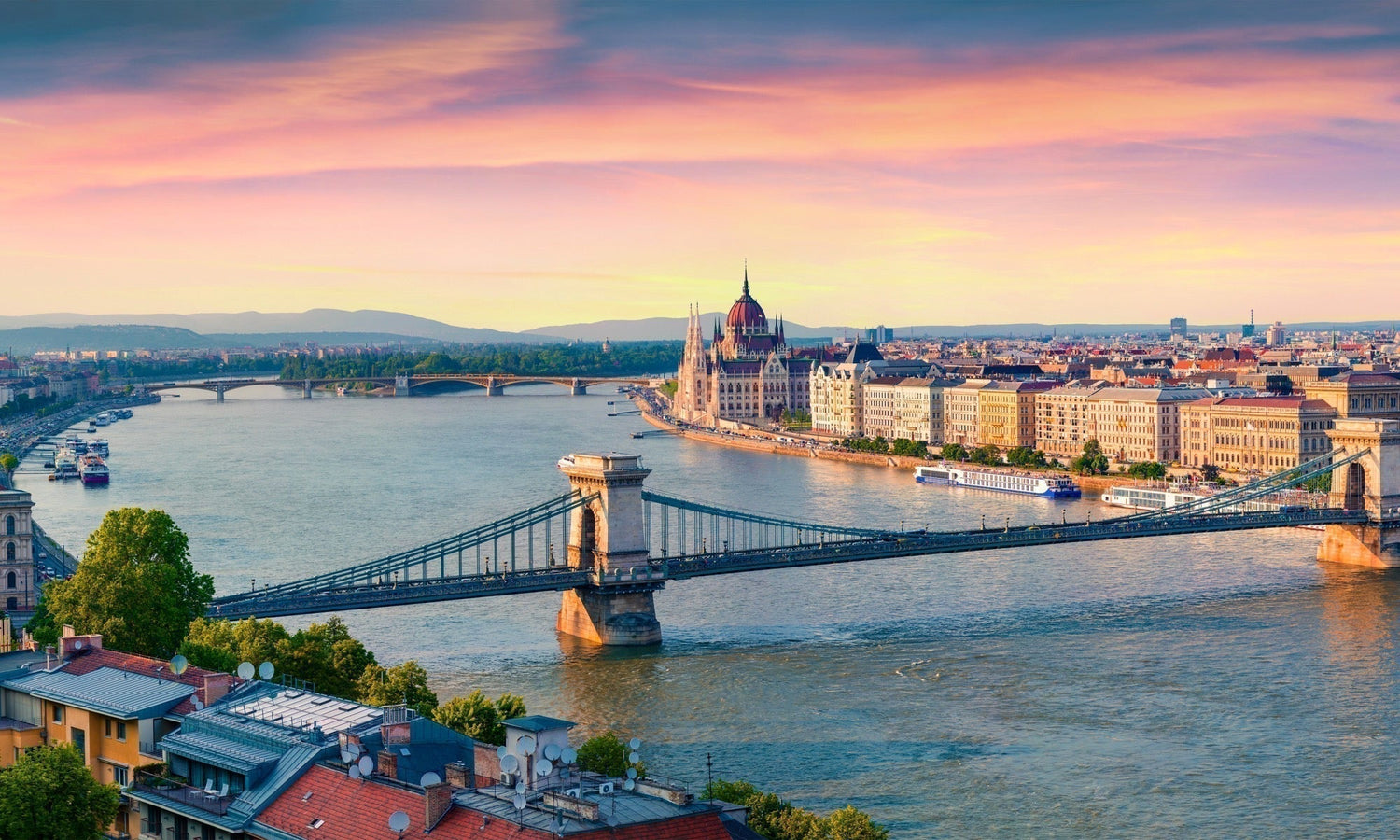
Budapest welcomed us with a smooth arrival this morning, and spirits lifted even higher when everyone realised their mooring was right in the heart of the city on the Buda side. A few lucky travellers even woke up to Parliament framed perfectly outside their cabin windows — not a bad way to start the day.

Most of us joined a morning tour of Pest, gliding from the boat along the Grand Boulevard toward Hero’s Square, where Hungary’s history stands proudly on display. From there, the bus crossed back to Buda and climbed to Castle Hill, the city’s oldest quarter and its historical soul.

Wandering through Castle Hill felt like stepping into a storybook — winding cobblestones, leafy promenades, baroque façades, Habsburg-era monuments, and cosy cafés tucked into quiet corners. Buda Castle now houses the Hungarian National Gallery and the Budapest History Museum, while the fairytale turrets of Fisherman’s Bastion offered sweeping views over the Danube and the elegant spires of Matthias Church. After some free time to explore, we strolled downhill with our guide, full of new knowledge and already smitten with this beautiful city.


 Public transport proved wonderfully simple — especially the trams skimming along the Danube — and many of us chose to explore on foot in the afternoon. Some visited the Parliament steps, others paused at the deeply moving Shoes on the Danube Bank, a memorial of 60 iron shoes honouring Jewish victims killed in 1944. Whether standing on the Chain Bridge or gazing from either riverbank, the views were nothing short of breathtaking.


As the sun dipped, we all gathered on the sundeck before dinner to admire Parliament glowing golden across the water — a true 6‑star view from their floating hotel. And after dinner, we returned once more, watching Budapest sparkle against the night sky until the lights blinked off at exactly 11pm. A magical end to a full and unforgettable day.


Day 8: MV Lisabelle - Wed 6 May| Horses, Markets & Ruin Bar Magic
A day of pure Hungarian magic. We kicked things off at the Putza Horse Show, where elegant horses and farm life stole the spotlight. A wander around the farm turned into a feast of local treats — rustic salami, fresh bread, and a warming shot of palanka (the schnapps that means business).


In the afternoon, we headed into Budapest’s buzz: a colourful whirl through the Central Market Hall, followed by an evening tucked inside the city’s iconic Ruin Bars; quirky, creative, and the perfect place to toast a brilliant day.


Countryside charm, city sparkle, and plenty of laughs along the way.
Day 9: MV Lisabelle - Thu 7 May | From Baja’s Markets to Mohacs’ History
A grey sky set the scene for today’s gentle ride between two charming Hungarian villages, a peaceful and beautifully scenic day on the bike.


 We began in Baja, a lovely riverside town just a kilometre from the Danube. Its colourful vegetable market was already buzzing, and the picturesque main square and cathedral made for a delightful wander before we set off.
As we cycled, nature put on a show. Vibrant purple wildflowers and bright red poppies lined much of our route, while lush fields and pockets of forest created a stunning backdrop. Even with the muted weather, the landscape felt alive and full of colour.


Our ride ended with a short ferry crossing to Mohacs, a town with a remarkable place in Hungarian history. Two major battles were fought here; in 1526 and 1687, marking the beginning and end of Ottoman rule in Hungary. It’s humbling to stand in a place where so much of the country’s story was shaped.


A gentle day, rich in scenery and history — the kind of journey that reminds us why travelling by bike is such a joy.
Next stop Belgrade!
Day 10: MV Lisabelle - Fri 8 May | Stepping Into Belgrade: A City of Layers and Living History
This morning we slipped quietly into Belgrade, a lively city of 1.9 million, just in time for breakfast. Border formalities were wonderfully simple, a quick smile and passport check with the border police right onboard our boat, and then we were on our way.
We’re moored in Zemun, one of Belgrade’s smallest and most charming communities, about half an hour from the historic centre. It’s a lovely spot to wake up to, with its riverside cafés and relaxed neighbourhood feel.


Most of our group joined a city tour led by two excellent guides who brought Belgrade’s layered history to life. We stopped at the impressive Church of Saint Sava; the largest Orthodox church in Serbia and one of the biggest in the world. Its gleaming white exterior, inspired by the Hagia Sophia, is every bit as striking in person as you’d imagine.


From there, we continued to Belgrade Fortress, the ancient heart of the city. For centuries, life here existed entirely within these walls, and wandering through them feels like stepping into the city’s timeline. Belgrade’s story is a dramatic one, razed 35 times, with 115 battles fought over it, and even today, reminders of the 1999 bombings remain visible, a sobering testament to the resilience of its people.


Our tour wrapped up at the start of the pedestrian zone, where we enjoyed some free time to wander, shop, or simply soak up the atmosphere. Later, we returned to the boat and spent the afternoon exploring the delightful riverside streets of Zemun.


Day 11: MV Lisabelle - Sat 9 May | Cruising the Iron Gate
Today doesn’t exactly dawn bright — in fact, it’s raining — but not a single spirit on board is dampened. We’re entering the legendary Iron Gate, and a little weather won’t stop the excitement.
After leaving Belgrade last night, the ship cruised through the dark, slipping into the gorge around 6am. A few intrepid early‑risers were up in time to watch the cliffs appear out of the morning mist; the rest joined not long after, driven by pure FOMO and the promise of spectacular scenery.

The Iron Gate marks the natural border between Serbia to the south and Romania to the north. Here, the Danube cuts dramatically between the southern Carpathian Mountains and the foothills of the Balkan Mountains. On one side lies Romania’s Iron Gates Natural Park, on the other Serbia’s Đerdap National Park — a landscape shaped by geology, history, and human engineering.

In its broadest sense, the Iron Gate stretches for 110km and ends in a vast basin holding two enormous hydroelectric dams, Iron Gate I and II. Construction began in the 1960s, raising the river level by 35 metres and requiring the resettlement of 17,000 people. It’s an astonishing feat to glide through.
Everyone is buzzing about the sights ahead:
- Golubac Fortress, a beautifully restored 14th‑century stronghold guarding the entrance to the first gorge.
- Mraconia Monastery, once submerged, now rebuilt and home to a single resident monk.
- The colossal 55‑metre King Decebalus carving, the largest rock sculpture in Europe, created over ten years by a team of sculptors.
- And the ancient Tabula Traiana, a Roman plaque honouring Emperor Trajan’s road carved into the cliffside.


 We also pass the modern structure housing Lepenski Vir, one of Europe’s most important archaeological sites and the oldest planned settlement on the continent — a reminder of just how long humans have lived along this river.
By midday, the rain has eased and the mood on deck is buoyant. The ship idles in the wide basin at the heart of the Iron Gate, giving everyone time to soak in the scale of it all. Glasses are raised with the captain to celebrate reaching the halfway point of our journey — 1,200km down, 1,200km still to go.


A grey morning, a grand gorge, and a group of travellers who know how to make the most of every moment. A perfect Iron Gate Day.
Day 12: MV Lisabelle - Sun 10 May | Serbia to Croatia: From Novi Sad to Ilok


Day 13: MV Lisabelle - Mon 11 May | Mohacs: A Change of Course
A change to our itinerary today saw us back in Mohacs. Batina doesn’t have a deep‑water port, and with the river level too low to moor there, we had to adjust our plans.


From Mohacs we had several round‑trip cycle options, but with limited time most of us decided to stay and explore the town. Six keen riders headed out, mixed and matched the route options, and enjoyed a comfortable 25km ride — returning with plenty of time for a well‑earned ice cream.


A quick side note: with river levels lower than normal, the going is slower than usual, which can mean delays or missing some ports altogether. (Not the best sign for the coming summer cruising season 😒.)
Day 14: MV Lisabelle - Tue 12 May | A Misty Budapest Morning


Day 15: MV Lisabelle - Wed 13 May | Cruising Into Vienna & an Evening of Music
Most of today is spent relaxing on the river as we cruise toward Vienna, arriving around 3pm. Our ship docks a few kilometres from the city centre, so many choose to stretch their legs and explore the local neighbourhood before an early dinner and tonight’s highlight: a visit to Schönbrunn Palace for an evening concert.


Usually the nightly opera performances take place in the Orangerie, but tonight we’re in for something special. Our concert is being held in the Palace’s historic Concert Hall — a rare treat and a truly memorable setting for an evening of music. How lucky are we!
Day 16: MV Lisabelle - Thu 14 May | A Day Exploring Vienna’s Grand History
We have all day to explore Austria’s capital and largest city, Vienna — renowned for its rich musical heritage. Home to many celebrated classical composers, it has played a pivotal role as a leading European music centre from the age of Viennese Classicism through to the early 20th century.
We get to know the historical centre using a Hop‑On Hop‑Off bus pass. There are several routes, earphones are provided, and the running commentary is highly informative. We start at the Vienna State Opera, do a full loop to get our bearings and decide where we want to explore on foot, then stop at a traditional coffee house — Café Museum — one of Vienna’s approximately 2,500 coffee houses. Around 850 are considered traditional, and 150 of those are highly specific historic establishments.
From the Opera House we hop back on the bus for one stop to Heldenplatz (Heroes’ Square), opposite the Hofburg Palace. Many significant events took place here, the most recent being Hitler’s ceremonial announcement that Austria would join Nazi Germany on 15 March 1938.


 We then walk through the Hofburg Palace, the former imperial winter residence of the Habsburgs, first built in the 13th century and greatly expanded over time. Today it houses several museums, including the Sisi Museum and the Albertina, and is home to the Spanish Riding School.

We arrive at Stephansplatz, the geographical centre of the city, named for Stephansdom — St Stephen’s Cathedral — one of the tallest churches in the world.


We continue to Schwedenplatz to rejoin the bus and take the Blue Line into the 2nd District to see Prater Park, a lovely green public space originally used as an imperial hunting ground and opened to the public in 1766. It’s also home to an amusement park featuring the world’s oldest continuously operating Ferris wheel, built in 1897 🎡.
Those who haven’t headed back to the ship take a trip on the Yellow Line to view Schönbrunn once more, along with the Upper and Lower Belvedere Palaces, now museums.
Whether it’s a Wiener schnitzel at historic Café Diglas or pork schnitzel onboard, we all finish the day replete with great food and vivid memories of a gloriously grand city.
Day 17: MV Lisabelle - Fri 15 May | A Perfect Finale in the Wachau Valley
Last cycling day today in the Wachau Valley. The route is filled with picturesque villages, colourful houses, medieval churches, fortified abbeys, castle ruins and terraced vineyards. It’s a stunning way to finish our Danube journey, and we now fully understand the hype surrounding the Wachau.


The sight of the impressive Melk Abbey is bittersweet, marking the end of our cycling adventure. Stift Melk is an active Benedictine monastery perched on a rocky outcrop overlooking the Danube. Famous for its golden‑yellow Baroque architecture, vast library and terraced gardens, it remains the cultural and spiritual heart of the Wachau Valley.


It’s hard to tear ourselves away from Melk, but we have to be on our way. This evening we’re treated to a Captain’s toast, with the entire crew parading through the lounge to rapturous applause. We’ve been so well looked after, and after two weeks, it truly feels like we’ve become part of a family.
Our seven‑course gala dinner follows — the team of chefs have done an amazing job once again.
Further celebrations continue back in the lounge: plenty of chat, a bit of dancing, and many bonds cemented. A wonderful finale to a very special journey.
Day 18: Salzburg - Sat 16 May | Farewell to the Danube, Hello Salzburg
Sadly, we pack our bags and get ready to farewell our wonderful crew and the new friends we’ve made on board. Our arrival into Passau is delayed by more than two hours, which creates a bit of stress for the crew as they work hard to prepare the ship for the next guests. A backlog of ships waiting for the final lock means we simply have to be patient — but it does give us another chance to marvel at the engineering feat of moving such a huge volume of water in such a short time.


When we finally arrive, the crew forms a human chain to unload the luggage, and we step straight onto the coach waiting to whisk us to Salzburg.
A comfortable two hours later, we arrive at the back entrance of our gorgeous hotel in the heart of historic Salzburg; the Goldener Hirsch. The front entrance opens onto the pedestrian‑only Getreidegasse, and the location couldn’t be better. Reception is reached through a delightful rabbit‑warren of corridors, and we learn that the first documents referencing the building date back to 1407. We’re staying in a UNESCO World Heritage building.

Some of us head out immediately to explore, while others take a moment to enjoy the 5‑star luxury.
Dinner tonight is in another historic building, not far from our hotel and directly opposite Mozart’s birthplace. A restaurant has operated on this site for more than 680 years. With many small rooms spread over several levels, we climb a narrow stone staircase to the top floor and our own private dining room, complete with original wooden furniture and traditional local colours. We enjoy a delicious three‑course meal — Wiener schnitzel and apple strudel included — a satisfying and fitting final dinner together!


Day 19: Salzburg to Munich to Dubai - Sun 17 May | A Stroll Through Storybook Salzburg
Salzburg is a hive of activity this morning - the annual Salzburg marathon is on. Many roads are closed as the course runs around the centre and finishes in one of the many squares – on our doorstep we have front row seats to the action. Runners and supporters are everywhere and energy is high.

At 10.30 we meet our guide Julia and begin our walking tour of the historic central old town. There's so much to learn about this wonderful place, and Julia is a fountain of knowledge.


 Salzburg’s incredible history is defined by Roman foundations, powerful prince‑archbishops, Baroque transformation, and its role as the birthplace of Mozart. The area was first settled in the Neolithic period, later becoming a Roman municipality. After Rome’s decline, the town fell into ruin until Bishop Rupert of Salzburg (now St Rupert) revived the site, founding St. Peter’s Abbey and Nonnberg Nunnery, institutions that still exist today.
We learn it’s always worth looking up - many houses have multiple dates painted on their eves which signify when the house was built, then renovation dates.
Before the general population could read, a symbol was the best way to advertise your wares if you were a merchant, and merchants continue this tradition. A Star above house meant a brewery, and there was no shortage of breweries. (Most brewers were women...apparently, a good way to attract a husband!?)
We head across the river Salzach to the Mirabell Palace gardens, well-manicured and bright in French baroque style, opened to the public by Emperor Franz Joseph in 1854. Famous outside Austria for scenes filmed in the 1965 Hollywood musical, The Sound of Music.


Our walking tour ends back on Getreidegasse at Mozarts Birthplace – the 14th century family house has been converted into a fascinating museum spread over several levels, showcasing his short life.

Counting down our final couple of hours in Salzburg, some of us choose to take the funicular to visit the Festung Hohensalzburg (High Salzburg Fortress) - a landmark visible from afar, the medieval Fortress towers majestically over rooftops of the city of Salzburg. Construction started in 1077, however since then, various renovations and additions have made it one of the largest medieval castles in Europe. Away from the city, we have breathtaking views of the snow-covered Alps - a spectacular vista and glorious finish to our final afternoon.



Leave a comment
This site is protected by hCaptcha and the hCaptcha Privacy Policy and Terms of Service apply.