
Cultural

Estonia, Latvia, Lithuania & Poland | June / July 2026

Estonia, Latvia, Lithuania & Poland | June / July 2026

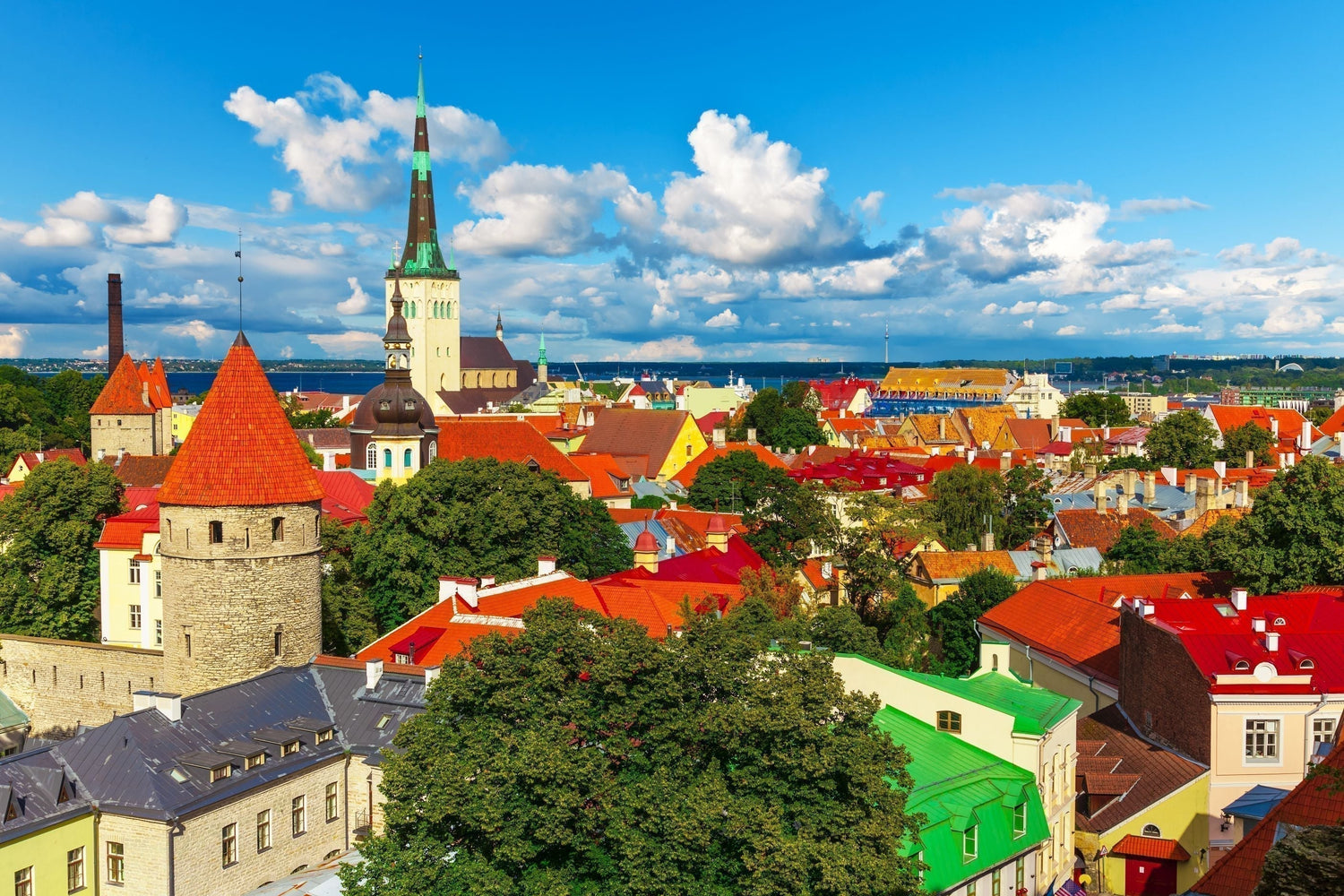
Follow our Baltics & Poland adventure as our group of Kiwis meander through cobbled streets, quiet villages, and centuries of Baltic and Polish history on this unforgettable journey.

Map:

Day 1: Tallinn | Wed 24 June | We made it!
After two flights of 10+ hours, we were very happy to touch down in Hong Kong for our stopover. 
Then onto Helsinki airport. As someone who has a name for recycled shopping, I was impressed to see a very upmarket recycled clothing store cum cafe in pride of place in Helsinki airport. 
Alas exploring it fully will have to wait until another visit, as we were running  through what seemed like at least 5kms of corridors to our small plane to Tallinn at the far end.   We arrived at our hotel to find that all the independent travellers had arrived safely, and had plans for exploring the city.   Plans sadly thwarted by dismal showers and a public holiday meaning that all shops and most other activities were closed.   23/24 June is St George's Day, celebrated as a spring agricultural festival, and marked with community bonfires - but not in the middle of the city.   However, most managed to find something of interest between showers, before meeting up for a welcome dinner, where it became clear, as introductions were shared, that we have a very widely travelled group, already finding common memories of places visited.
Day 2: Tallinn | Thu 25 June  | Tallinn: Where Our Story Begins

A perfect day for the start of our tour proper, and a perfect introduction from Jelena, our very well‑informed city guide, and Max, our Swedish Tour Manager (the tall and the short of it).

Jelena shared a wealth of information about the history of Tallinn and Estonia, including fascinating details about how local government and decision‑making worked, leaving us with a picture of a proudly independent and effective populace. Although the country had been controlled by a variety of other nations at different times, it was only during the Soviet period from 1945 to 1989 that its proud nationalism was actively suppressed.

The country now has a population of 1.5 million, around a third of whom live in Tallinn, and it has a strong focus on technology, with 5G Wi‑Fi universally available and the highest level of investment per capita in technology start‑ups.

Our stops included several historic churches, the Town Hall; a perfect place for a formal group portrait, Kumu, the national art gallery, where we enjoyed an excellent presentation of history through art from Robin, a gallery guide, and finally the impressive Kadriorg Palace, built for Russia’s Peter the Great.

A reminder that it is midsummer was the light level of the 11pm view from our hotel!

Day 3: Riga | Fri 26 June | From Tallinn to Riga: A Day on the Move 

We set off in lovely sunshine on the next step of our journey to Riga, in Latvia. We have comfort and plenty of room in our very large bus, which will be with us all the way through to Poland. Our friendly Lithuanian driver, Algis, is an interesting man: he owns the bus and has a strong interest in classical music. His wife and one daughter play in the Lithuanian National Orchestra, and his other daughter plays in the Vienna Philharmonic, until recently, the last male‑only bastion.

Max used the travel time to cover more general history of the region, in particular the split between the Roman and Orthodox branches of Christianity. As we drove through the very green countryside, we were struck by the lack of fences and the absence of animals. The crops looked healthy, but who is going to eat them?

We were also intrigued by the forested areas, which had clearly been deliberately planted. The trees seemed very close together and therefore quite thin compared to those in New Zealand, but our new guide, Daiga, who met us at lunchtime, assured us that they are harvested and used for construction and furnishing timber.

After lunch we visited the very picturesque Gauja National Park, home to the 13th‑century Sigulda Castle, rebuilt many times over the centuries and recently partly restored. The park also featured a striking sculpture area.

Our dinner restaurant, directly opposite our hotel, provided a very relaxing introduction to Riga.

Day 4: Riga | Sat 27 June | From the Old Town to Canal Cruise

We headed out a little nervously on foot in Riga, as the forecast warned that the heat sweeping Europe, so far missing us, was finally arriving, with a predicted 30°C. Thankfully, the morning stayed pleasantly cool for our walking tour through the Old Town. Daiga, another excellent local guide, shared Latvia’s history through its buildings, including a powerful street display of information and images from the late‑1980s blockades, and we even paused to enjoy some street musicians.

We rounded off the morning with an impressive organ concert in the Dome Cathedral. A live video projection of the organist showed the complexity of managing all the stops and registers, as well as the major physical effort involved in handling pedals and keyboards at the same time.

Lunch in an attractive restaurant specialising in Latvian cuisine was followed by a canal cruise, departing from a beautiful central park filled with cool greenery; a welcome contrast to the steadily warming day. After the cruise, we visited the National Gallery, also in the park. The gallery is a beautifully restored heritage building, completed with a striking modern space in its dome.

We ended the day with a stroll back through the park and the Old Town to our hotel, feeling very grateful that the temperature never reached the promised (or threatened!) 30°C during our walking day.

Day 5: Riga | Sun 28 June | Architecture, Culture and a Very Loud Evening
En route to a morning of Art Nouveau, our guide took great delight in having us driven  along the street in which the Russian Embassy is located.   The street was renamed "Avenue of Ukraine Independence"  In a building opposite the embassy there is an exhibition on protest and a large version of one of the works appears on the wall directly opposite the embassy.

We then walked through the area where a concentration of Art Nouveau decorated buildings is registered as a UNESCO heritage area.
Next, we headed out to the outskirts of town to an outdoor museum, warehouses and other buildings from all parts of Latvia have been relocated in an extensive woodland area.   A Lutheran church, which is still actively used, was a particularly interesting stop on our stroll through the trees.
When we returned to the old town, we had a tasting of Black Balsam, a Riga speciality coffee liquor.


Some of the group fitted in an additional activity in the evening. We had been told that there was to be an attempt for a Guinness world Record - to have the largest number of boats assembled sounding their foghorns!   A happy crowd were enjoying the early evening alongside the river, with boat owners relishing the chance to make as much noise as they could.
Day 6: Klaipeda | Mon 29 June | A Day of History and Heart
A long drive today cocooned in our air-conditioned bus from the 32deg+ temperature.
Our morning stop was at the baroque Rundale Palace, designed by Rastrelli, who also designed St Petersburg's Winter Palace. 
Our delightful guide (yet another with perfect English) filled us in with all the intrigues of the family of the original owner, the Duke of Courland, a favourite of Russia's Empress Anna, as well as with the more recent history, and restoration from 1972 onwards. A stroll in the (very warm) garden was followed by lunch at a country restaurant.

In the afternoon the heat really caught up with us at the Hill of Crosses, a symbol of faith and perseverance, regularly torn down during the Soviet era, but regularly rebuilt by locals and Lithuanian patriots.
Day 7: Klaipeda | Tue 30 June | Forest, History & Palanga

A perfect day today. Still bright sunshine, but comfortably cooler for a bus ride to a remote forest area, which once hid the Plokstine missile base, now converted into a cold war museum. The underground temperature was "frisky" a new word for our vocabulary, from yet another site guide with perfect English. 

It was interesting to see the timeline of the cold war episodes, and to see where soldiers lived during that time, but what always brings reality home are the personal stories.   Regina, our Klaipeda guide, told us of her grandfather, an efficient crop and animal farmer, had his farm taken from him during the soviet period, to be handed over to be (badly) run as a collective, with all the crops and produce going to the state, while he and his family still had to work it, but with no income. His daughter, a devout Christian, prayed for better things to come, and ended up with 15 years in a mental asylum - because anyone who believed in Christianity was assessed as clearly mad.   After independence, 45 years later, and after the grandfather's death, the family received some compensating land, but not their original property, which had been developed in the meantime.

We then moved on to the beach resort town of Palanga, where we had lunch before visiting a gallery devoted to the works of Antanas Moncys, a Lithuanian artist who had fled to first France, then Germany to pursue his career in sculpture, painting and ceramics. 

He was internationally recognised, but was not able to share that with his family until 35 years later, when he came back, and donated his collection of works to be shown in the local gallery.

The gallery was near a magnificent 100ha. park, surrounding a stately home, designed by a French architect and a Belgian gardener for Count Tyszkiewicz. We had a lovely shady stroll through the forested park, with a couple of diversions - one to climb the sandhills and look down on the adjacent beach, and another to climb a small hill, where a much loved local figure of a young pagan priestess in the 13th century is recognised with a sculpture and a small chapel at the summit. At the foot of the hill is a grotto, created as a copy of the site at Lourdes. During Soviet times, this was not allowed to be used for Christian gatherings, being used instead of poetry readings and other cultural gatherings, but locals came to pray anyway.


Day 8: Klaipeda | Wed 1 July | Wandering the Curonian Spit in the Rain
The rain caught up with us today - not a deluge, just enough to keep the umbrellas up all day, as we headed in the bus for a short ferry ride to the Curonian Spit, a very long narrow stretch of land, luxuriously wooded for the Northern half, and including an attractive beach settlement at Neringa, before stopping at the Hill of Witches, where a fascinating array of carved wooden sculptures lined the paths.   The sculptures were only started in 1979, but represent a centuries old tradition of pagan beliefs and folk tales.
Next stop was the town of Nida, where we stopped to look out towards the Russian enclave of Kaliningrad.   This area was previously occupied by Germans, but after WW2, the Russians took control and have kept it ever since as a base, which is surrounded by very bleak sand dunes.   Appearing to fight the wind on the way up to the lookout point was a sculpture of Jean Paul Satre, who had been a frequent visitor to the area.
Before lunch we had a pleasant walk through the small port town of Nida, just North of the Russian enclave, and also visited an amber museum there. It is a world recognised area for the recovery of amber.
We then had a boat trip back down the coast to the Russian border, and heard interesting descriptions of life in the area from the boat captain.   It was interesting that he said that before the Ukraine war, he and other sailors in the area were on good terms with the nearby Russians, but regret now having lost contact with them. 

Back to Klaipedia at the end of the day for a walk in the historic part of the city, where we started in Theatre Square, where Hitler had given a speech, reclaiming Klaipeda for Germany.   The centrepiece of the square is a lovely sculpture of a Klaipeda girl, who was the heroine of a Simon Dach song, and is much loved by locals. Regina, our guide took us on a brief tour through the historic area, telling the stories of a number of sculptures and other sites, which had been totally missed by a group dining nearby the previous night. Shows the value of having a well-informed local guide.

Day 9: Kaunas | Thu 2 July | A Day of Heritage, History &… Cucumbers!
A relaxing drive across open countryside - on high-quality 4 lane highways, took us to the attractive town of Kedainiai, where we were welcomed by yet another very pleasant and knowledgeable guide with flawless English, who covered the history of the town, through its buildings and heritage, particularly it's significant Jewish heritage. Jews had a strong presence in the town right through until WW2, when thousands were transported and/or killed, often with compliance from the Lithuanian residents. Any who survived left after the war, finding it too painful to stay. Synagogues in the town were given to the local government and are now used as a museum and a community centre.
It was intriguing to hear that there had been quite a strong strand of Scottish immigration historically, and the Scottish thistle can be seen on buildings and furniture. We were impressed with the skill in making paper curtains, (cheaper than fabric) which were on display in a folk museum, the hand cutting is amazingly delicate.
But the big claim to fame of the town is as the cucumber capital of the country (of Europe?).   We visited a specialist shop selling cucumber sweets, cucumber beer, and cucumber liquors! The dessert served with our lunch was cucumber ice-cream, pleasant enough, but most agreed they wouldn't chase it again.
After lunch, another hour on the bus brought us to Kaunas, the second largest city and former capital of Lithuania. At a specialist museum we were introduced to the art and music of Mikalojus Konstantinas Curlionis. Our lovely guide explained the symbolism of his paintings, which were intriguingly mystic, and this was followed by a piano recital of his music compositions. A formidable talent, who sadly died at 35!

There was an attractive group of children in the gallery, interacting with the art as only the modern generation can.

Day 10: Vilnius | Fri 3 July | Beautiful Baltic City
The lovely Rolanda took us to get an orienting view over the city of Kaunas, before taking us for a walk through the historical area, after showing us the marker with maximum river heights before an upstream hydro station controlled the river levels. 
Highlight was a beautiful baroque cathedral beside the lovely spacious town square. 
This was followed by a visit to the Sugihara House, a beautifully curated tribute to the efforts of a Japanese diplomat during WW2 to provide visas to thousands of Jews wanting to escape (across Russia and via Japan).   This was contrary to the instructions of the Japanese government, and later cost him his position. 
Lunch in the central city was rounded off with a cherry and mascarpone dessert, which was a great favourite.
After checking out the main pedestrian street, we headed to the outskirts of the city to the 9th Fort, built for protection in 1914, then used between the wars as a prison, and during WW2 as a concentration centre where some 70,000 Jews were massacred.   The fort had a number of very moving displays, from small personal stories to the mammoth memorial which loomed over the area where bodies had been piled into trenches.
An hour and a half by bus brought us to Vilnius, the capital, to our well-located central hotel. 
Day 11: Vilnius | Sat 4 July | More History
The delightful Justina, our best guide yet (which is a pretty high bar!) brought the history of Vilnius alive during a walk through the old town this morning.   We were intrigued by an interactive video display in the town hall square outside our hotel, which is linked to street scenes in 8 cities around the world, allowing locals here to interact with whoever happens to be walking past at the other end.   
Other points of interest included sculptures which related back to the city and country's pagan past. 
Lithuania was the last country in Europe to adopt Christianity - in the 14th century.   Another stop was at a wall where artists had created small works of art related to Lithuanian authors, or works about Lithuania.  We walked through a once bohemian enclave, which had declared itself an independent territory, and celebrates this each year on 1 April.
We also toured the crypts in the basement of the cathedral and stopped off at Vilnius University, to view the gallery of lost languages, where our guide gave us a history of how the Lithuanian language fits into the family of Indo European languages. 
After lunch in the centre of town, we met our bus to go to the KGB museum, where we learned of the persecution of Lithuanians mainly during the Soviet period in the 20th century, but also during WW2, resulting in large numbers being either killed, transported to Siberia, or for a lucky number, escaping to the West. Once again, our guide's commentary made the negative feelings towards Russia and Putin very clear, for example in a huge sign on top of the city administration building "Putin, the Hague is waiting for you" and in a number of posters and banners in the streets. We stopped off on the way back to the hotel to view the strangely white baroque of the church of St Peter and St Paul 
Day 12: Vilnius | Sun 5 July | Kings & Castles
A great chance to share a holiday weekend day in the country with locals celebrating the anniversary of the coronation of the first and only King of Lithuania (they later became dukes) in the 14th century.
We had a relaxing boat trip on the lake around Trakai castle, before doing a tour of the castle.   
Many of us followed this with a lunch of Kibinai, a pastie like pastry filled with meat, which was brought to Lithuania by a small group of ethnic Crimeans, who came some 600 years ago. They were of Turkic origin and practice a form of Judaism.   We called at a small museum to learn more of the group, before heading to Kernave in the Pajauta Valley, where we enjoyed a combination of a heritage festival and street market, before heading back to Vilnius for dinner. On the way back to our hotel, we were treated to a concert, with dancers, from the Ukraine. The crowd response made it very clear where their sympathies lie.
Day 13: Warsaw | Mon 6 July | Poland Today
After a quick morning check on emails, we had fine weather for our extended bus ride to Warsaw, in relaxed comfort, thanks to Algis' usual great driving, as we went on our world tour via the Trans Siberian railway (twice), to China, Pakistan, both the North and South pole regions, including an interlude with Grey Whales off the Siberian coast, and coming back overland from the UK to Kathmandu, and stopping for a quick season in Fiordland.   Max shared some insights from his extensive travels, which served to join up parts of our world tour.
We said a reluctant farewell to Algis when we arrived in Warsaw in time to relax before heading to a local restaurant for our last dinner with Max.
Most of the group then headed for an evening walk in the old town - not trusting to be able to stay away from promised thunder showers tomorrow?
Day 14: Warsaw | Tue 7 July | Ghetto & Chopin
Sadly a rather grim rainy morning for our tour of the old town with Guide Agnieszka, but it was very interesting to learn how completely restored the area had been after comprehensive bomb damage during WW2.   
We stopped off for some welcome shelter and a lovely Chopin concert at the Fryderyk Concert Hall.
In the afternoon we visited the Royal Concert, originally built in the 14th century and evolving over time.   Photographic images  of the 20th century destruction brought home how total the rebuilding had been.
We also visited the monument of Warsaw ghetto heroes, and learned a lot about the history of Jews in the city, both during WW2 and through history.   A magnificent museum has been designed by a Finnish architect
Day 15: Krakow | Wed 8 July | A Walk in the Park
Before leaving Warsaw, we spent the morning in the impressive Lazienki Royal Park, landscaped in 1764 as part of the king's residence.  After viewing a Chopin memorial, we visited a display of classic and Polish sculpture in the orangery, where we were also lucky enough to glimpse an opera rehearsal.   
The Palace on the Water and the Myslewicki Palace were both lavishly decorated, and sat beautifully in the stately grounds, where the local residents seemed unafraid of the many visitors.
We enjoyed a lavish lunch before departing for Krakow on an impressive 4 lane highway, and were welcomed by a pleasant evening for an initial stroll around.
Day 16: Krakow | Thu 9 July | Original Old Town
A long day, but well worthwhile.   We started with a (wet) city walk in the old town, stopping to learn the history of the main market square and its treasures.   
We were intrigued with the bugle player who plays following the chiming of the hour at St Mary's church. The bugle players are all fire service personnel, who work 12-hour shifts, playing every hour.  The call originally signalled the raising and lowering of the town's main gate and was sounded as a warning. It is cut short in recognition of the fact that historically a bugle player was shot in the throat by a Tattar attacker.
A modern curiosity in the square is a sculpture of a head of Eros by Igor Mitoraj, who had a mahoe exhibition displayed in the square and gave the work to the city on condition that it stayed in the square.   This caused issues with the strict UNESCO recognition requirements to keep to original buildings and decorations only.   The compromise was to tuck the head somewhat out of sight behind one of the churches.  Julia, our guide, suggested that the sculptor might not have been so keen if he had envisaged children (and others!) climbing inside to peer out through the eye.
We also learned about the importance of the visits of Pope John Paul to the city.
In the afternoon we travelled the 77kms out to Auschwitz, and Auschwitz-Birkenau, where preserved artifacts and images of the atrocities really bring the horror of the holocaust into harsh focus.   The statistics of the huge number of people who were treated so horribly are very confronting.

Day 17: Krakow | Fri 10 July | Museums and Universities
We were pleased to head out on another city walk without the coats and umbrellas, but sadly it didn't last through until our free time in the afternoon.
We started the day with a fascinating tour of the museum at the Jagiellonian University, founded in 1364 by King Casimir the Great. Before the tour started we had to pause for a very special marking of the hour.  The treasure of the museum were both historical and more modern, with a collection of movie awards donated by a noted Polish Director, who's awards included an Oscar, a Palm d'Or, and a Berlin Bear among others.   
We learned about famous students, including Nicolaus Copernicus and Pope John Paul II.  here was a winner of a Nobel prize for literature, and there could have been more Nobel prizes if the university hadn't refused to admit women, including Maria Sklodowska (Marie Curie, who had to turn to France for study).  
We then visited Wawel Castle, occupied by Polish Kings from 11th Century, but mainly constructed and decorated by King Sigismund in the 16th century.
Our final stop was at the Wawel Cathedral, adjacent to the castle, which has an amazing array of richly decorated side chapels.

Several of the group used their free time in the afternoon to visit a museum under the main market square and were very impressed with it.
The venue for our farewell dinner was on the other side of the square, so it was interesting on the way to and fro to see the square and the old town lit up and lively in its evening attire.
Day 18: Depart Krakow | Sat 11 July | Time to say Goodbye
How sad to realise that we have come to our last day together - a nice fine day for the trip to the Wieliczka salt mine. It is humbling to realise the amount of work which has been undertaken over the mine's 700 years of operation to excavate to a depth of over 330m, creating 287 kms of passages, most of it dug by hand through the earlier centuries.  Our 3.5km walk through the designated visitor route covers less than 2% of the mine's passages.
We passed exhibits showing how the mining work was done at various times, but the thing which impressed us most was the number of sculptures, chapels and churches which miners had created - working in their own time, complete with beautifully crafted chandeliers composed of salt crystals.
There were also spectacular galleries reflected in underground lakes. Altogether a fascinating experience to finish our trip.
Members of the group headed away at different times, with 6 sharing the tour provided bus to the airport and then facing a range of very trying flight delays, and other problems. We should have stayed in Poland! However, other adventures were eventually enjoyed on the way home - to be shared later, as group members relax at home and plan for the next trip.

If you’ve enjoyed following this tour, you might like to explore some of our other adventures:

Active Tours Cultural Tours Wildlife Tours

Reading next

Way of St James | May / June 2026

Leave a comment

This site is protected by hCaptcha and the hCaptcha Privacy Policy and Terms of Service apply.