
Cultural

Algeria Research Trip | March 2026

Algeria Research Trip | March 2026

Travel alongside Mandy and Richard as they explore Algeria — a country rich in history, dramatic landscapes, and warm hospitality. From wandering ancient Roman ruins to exploring vibrant cities and the edge of the Sahara, they uncovered a destination that feels wonderfully untouched and full of surprises.

Mon 16 - Tue 17 March, 2026 | Auckland to Algiers, the long way round.

Each time I start a journey to somewhere new there is that quiet thrill inside; an adventure is about to begin. The first hurdle Richard and I had to overcome was to get to Algeria with the current difficulties in the Middle East. Our work around was NZ to Australia to Singapore to Istanbul to Algiers – a total of four flights and would you believe each one was delayed – yet we and our luggage made it!

Arriving into Algiers we saw sharp glimpses of green and grey. The airport was similar to many airports built or renovated around 1980 – lots of concrete, pillars and large halls. It happened we arrived at the same time as several other planes and I had that isolating feeling that I was a minority of one: blue-eyed, Caucasian, female traveller.  Thankfully there were many passport booths open and one of the many, many officials in blue uniforms with military hats directed us to “40”. I think that was one of his few words in English. Nevertheless, anything between 39 – 45 seemed fine and our official’s short, abrupt demands were dealt with. Off to the side we went into a neglected waiting room which smelt of smoke and our passports and documents went off somewhere else.

 After paying the Visa on arrival fees and observing lots of blue uniforms saluting each other we were reunited with our passports and we were free to find our luggage (happy hop that it arrived) and into Algiers. A sea of noisy people and no guide to be seen. Then a tall smiling man with dusky Arab/African features introduced himself – Sofiane Bacha. “Thank goodness”, I thought as step two was beyond my tired brain.

Out into the carpark and French cars parked and not parked and a traffic jam which took 30 minutes to get out of. Out of the airport and we were zipping along the motorway into the white city of Algiers. White buildings tumbling down the hills into the blue Mediterranean Sea. Everywhere resonances of Paris from ornate lamp posts to white road signs to elegant buildings. A beautiful white city with narrow streets dotted with palm trees. 

Bed for these tired travellers and more tomorrow.


Wed 18 March, 2026 | Algiers – Cherchell – Tipaza – Algiers | U the Coast

So far we had seen no other tourist – its like the world got a memo and we missed it. Still, it’s nice to be somewhere quiet and nothing was as quiet as breakfast; all the food was laid out and no one around, not even attendants. We have arrived in Algiers as Ramadan comes to an end so no eating or drinking from sunrise to sunset – except for soft Westerners.  

We met up with Sofiane at 9am and it off up the coast to the town of Cherchell. Once the capital of the Numidian kingdom, today it’s a pleasant, dusty town lined with small shops. Men wearing traditional Djellaba, a long robe and women wearing something similar but with a head scarf.

First stop was the museum and as Cherchell is on the coast our carpark overlooked the harbour and its many fishing boats. The bounce of colour from the boats was met by the intense blue sky and golden rocks. The museum was small and had wonderful pieces of Greek, Roman and Egyptian statutes. Egyptian? I hear you question. Let me introduce you to the strange yet true story of the daughter of Cleopatra VII who came here to marry the Numidian King, Juba II in 3 BC.  And yes, she was the daughter of that Cleopatra and Mark Antony. 

Back on the road we travelled to the ruined city of Tipaza, a city with a long tangled history of settlement, military action, roman life and eventual abandonment. (A very brief history line: Algerian ancestors, Phoenician traders, Greek Influence, Roman Occupation, Vandal Destruction, Byzantines Resettlement, Ottoman Conquest, French Colony, Algerian Independence) We were met at the gate by our local guide and Sofiane did an able job of translating the guide’s French into our English and keeping the man on track. Tipaza today is recorded as a vast Roman town upon three hills; in reality it’s partly uncovered buildings amongst trees and bushes. We started at the amphitheatre (built on top of the Punic graves) and then walked to the market area where the two streets found in any roman town intersect. Temples to the left and shops to the right. Moving to the most significant area where there was the remains of the basilica which overlooked the sea and a view to the distance mountain. Tipaza was once prosperous and busy, if the size of the theatre and the horse troughs are indicators.

To me, Tipaza was sleeping, waiting for the archaeologists to come and unearth its multiple wonders; it’s bustling roman life with the ships bringing goods from all over the empire, the tension as that new religion Christianity was introduced and of course the everyday life of the people from cooking to bathing to bringing up their children.

Next on our list of sites was a visit to the Royal Mausoleum of Mauritania and back to our story of Cleo and Juba. Here was their tomb, high on a hill with panoramic views of the Mediterranean. Juba built the mausoleum for his family with a reference to pyramids. Unusually its round with four false doors. A French archaeologist broke into the tomb through the floor beneath the Eastern door. All in all it looks like several people had a go at dismantling the structure. Huge oblong stones were thrown on the ground and some of the walls severely damaged. Nothing can take away from its viewpoint and dominance on the horizon line.

Sofiane played us his favourite music on the drive back to Algiers and we accompanied him to dinner so we could see how the faithful break their fast during Ramadan. Seated at a low table our cheerful waiter brought several dishes including dates, carrots and eggplant. Soup arrived but poor Sofiane waited until the legal time to eat: 7.01pm. Soup was followed by chicken and a vegetable mix; finally apricot sweets which Sofiane assured us contained 1 million calories each. He dropped us back at the hotel and planned to have another snack before sleep and waking early so he could eat before sunrise. 


Thu 19 March, 2026 |  Algiers to Constantine | Top of the Rock

An early start as we were flying to Constantine and it was the Thursday before the end of Ramadan (tomorrow). The airport was slammed with people trying to get home. Quick flight to Constantine and our new local guide Abla. This lovely female guide is going to look after us for the next two days. 

First stop was the Emir Abdelkader Mosque. I wasn’t ready for a mosque, so Abla took me to find a covering for my trousers. Can I say there was once again No One Around. This beautiful, huge mosque was something else. I have visited many mosques but the interior of this one was a harmony of greens and creams. Everywhere were decorations and the most impressive were the stained glass windows. As we were visiting the morning light split the colours across the carpet. Tomorrow 120,000 people can be accommodated for the special Ramadan Friday Mosque. When we were leaving a cleaner asked me what I thought of the Mosque. “Beautiful”, I said. His reply, “ We have a saying, beauty is seen with beautiful eyes.” Nice. 

Next Abla had kindly arranged coffee for us and a small break before discovering more of this city on a rock. Its an enormous rock plateau  with steep sides and once again is a story of civilisation upon civilisation. Abla arranged for us to visit the Palace of Ahmed Bey. This place was very demure on the outside and a riot of colour in pattern on the inside. The Ahmed had travelled extensively and so had a mural painted of his adventures along the many corridors. Internal gardens and lush rooms, this palace was a visual delight. My favourite area was the harem where a swimming pool placed in the courtyard was beautifully proportioned.

Out into the busy marketplace of Constantine and lots of locals out and about buying new clothes for children (a tradition for the end of Ramadan) and food for the celebrations. Most people wore the traditional dress or the modern interpretation of it. Alba promised me we will go to a women’s store so she can explain the clothes. (Watch this space).

Abla wanted to show us the seven bridges of Constantine which included a natural bridge, lower bridges across the river, pedestrian bridges and vehicle bridges. As mentioned, old Constantine was built on a rock so the more modern bridges are the link between the rock across the gorge to the next plateau or new Constantine. It all makes for a different and interesting location with incredible views.

Last stop before picking up our police escort (oh yes, tourists in Algeria are required by law to have police escorts. I don’t think there is any danger; its more to ensure help is on hand if needed). Rich and I had a sneaky quick lunch (because of Ramadan) in a closed restaurant on the bottom floor where no one could see.

Quick visit to the museum with its highlight of mosaic floors and perfectly intact glass and pottery. 

Then it is was zoom zoom out into the countryside with our three tall policemen in their small car. We were off to Tiddis, another roman site built on a hill as a garrison outpost for Constantine. Built on top of Neolithic caves its was tumbled ruins in the middle of farmland. Literally the road ended at Tiddis and high on the hill there was silence and uninterrupted views to Constantine. I was all for looking for the roman road which once linked Tiddis to Constantine but time didn’t allow – no doubt its been ruined by modern farming.


Back to Constantine and an early night.

Fri 20 March, 2026 | Constantine – Djemila - Constantine | Mosaics
A later start to the day as it was the end of Ramadan and lots happening for family gatherings. The driver, Madjed turned up in traditional dress with brown hooded ‘kachabia”, It can be made from camel hair or wool; he did look smart. Abla gifted us with a beautifully presented box of traditional small baked goods she had made herself. Apparently in Algeria families gift each other these boxes on this day; wasn’t it nice of her to make one for us. Delicious!

 
As expected the roads were very quiet today and our two hour trip to Djemila was punctuated with stops for our police escort to change over. Each time the men greeted each other with 4 kisses on the cheek, right and left, a firm handshake and many happy smiles. There were jokes and smiles and many comments about the driver’s outfit.
 
Djemila is the ruins of a roman city on the edge of a modern town. Built to accommodate soldiers who had served in the Roman army for 20 years it was a site which rolled down the hill from the more recent Christian neighbourhood to the most ancient main square. Just before we went to look at the ruins we popped into the museum. It was one of those overwhelming moments as every wall was covered in mosaics found in Djemila and preserved here. The detail, colour and designs were mind blowing.
 
Starting at the nearer and newest section (the Christians neighbourhood), we followed the chequer board pattern between rows of recognisable squares and shapes of walls. Nothing was above shoulder height and in the empty spaces between were covered in wild flowers. There was a slight breeze but nothing disturbed this silent world of long ago Rome in North Africa.
 
Next to this neighbourhood was the remains of the millionaire’s mansion. Five times the area of a normal home its beautiful floors now in the museum and its frescoes lost to the weather. Moving down the hill we came across the baths, the gymnasium and public toilets. In the distance we could see where the Cardo Maximus (main street) entered the main square, the arched gateway, and the nearly complete temple. Pillars, stones, walls and flowers as far as we could see. The absence of people just made it all seem so abandoned and lifeless.
 
We played at being Romans for a while until it was time to return to our driver, the police escort and our drive back to Constantine. Time to say goodbye to Madjed and Abla. Another satisfying day in Algeria.
 
Sat 21 March, 2026 | Constantine – Timgrad – Lambaesis – Biskra
Sofiane was back today and his wife and mother had prepared a box of baked goods for us. More deliciousness. The police escort was also back and the usual kissing and handshakes between men. We have some distance to cover today starting with our drive south to Timgad. We have heard a lot about this place so let’s see if it lives up to its reputation. On the way Sofiane explained the brief history between the French leaving and modern times. It’s a turbulent history and modern Algeria is a result of many new reforms. The police escort concept is 20 years old and is a traditional protocol.
 
Timgad, yes another Roman site but this one is impressive with its level of reconstruction and clear outline of how the city functioned. The inevitable Cardo Maximus (north-south axis) and the Decumanus (East-West axis) was bisected by the lesser lanes in strict accordance with roman city planning. The different sizes of houses, the baths, the theatre, market and forum – all were easy to identify and appreciate. Our English speaking site guide was very enthusiastic to tell us about roman hierarchy but also that the Algerian revolution against the French started here. From retired roman soldiers to last century guerrillas; a huge expanse of time and only goes to reinforce the saying that as much as things change, they remain the same.
 
It was a great visit, but we still had a lot of travelling to do, so we pushed off to visit Lambaesis, once the garrison for the 3rd Roman Legion. Not much remains and much of the site’s stone is now part of the maximum-security prison the French built a mere 100 metres away. The best part of the visit was seeing the amphitheatre and in particular where the wild animals were lifted up into the arena to fight the gladiators. Sadly the museum was closed so I missed out on my dose of mosaics.


We drove on to our hotel for the night in Biskra. From outward appearance this is a prosperous town with many fountains, wide streets and lots of business.
Sun 22 March, 2026 | Biskra - Ghardaia
A long drive ahead of today as we head into the Sahara. The usual police escort changing as we moved. In general the police were waiting for us, so the change over was fast; however sometimes we had to wait for the formalities, kisses and note taking.
       
 
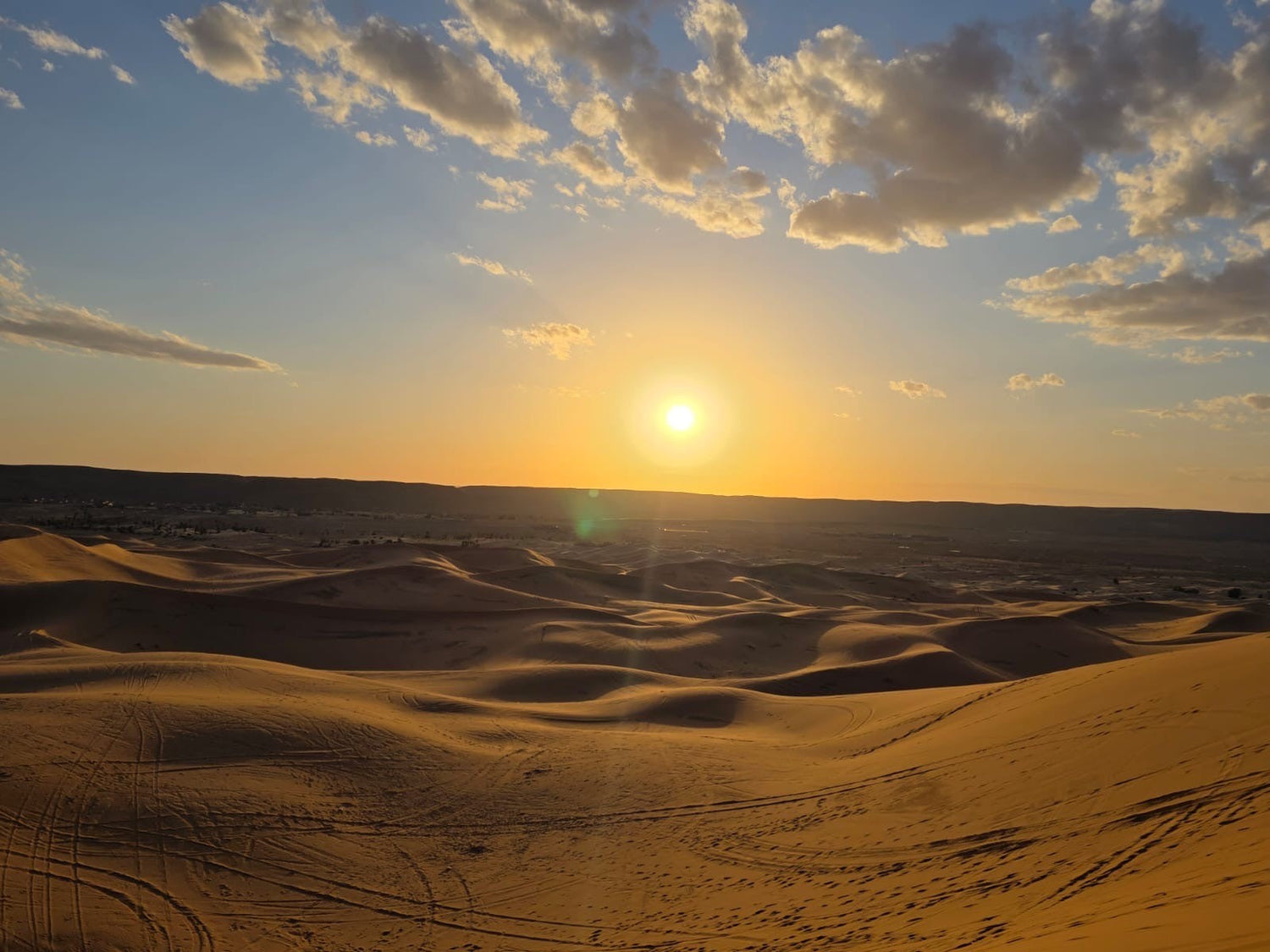
Up over a ridge and round a bend and there was the Sahara, sand to the horizon with multiple subtle colour changes. Raw and bright, the sand spread in every direction.
 
On the road somehow I turned into DJ Mandy and we sang our way across the edge of the Sahara. At one of the police changes a herd of camels crossed the highway and disappeared into the dunes.
       
 
Arriving into Ghardaia was like entering a painting. Women dressed head to foot in white flowing gowns and scarves with only one eye visible. The buildings painted shades of sand to ochre and the intense green of the river valley.
 
Mon 23 March 2026 | Ghardaia and the M'Zab Valley

The holidays are definitely over as the streets are full of traffic, people walking and children about. There are five villages in the valley, each one distinct and preserved by UNESCO. Our first village to see was El-Atteuf. Built on a rocky hill this village is crowned by a mosque with its houses cascading down the slopes with narrow, winding streets.  Only pedestrian traffic or donkeys were on these lanes. The walls are compacted gypsum with the ground floor having only doors on to the lane and windows on the first floor and a roof top area. Covered archways reinforced walls and add shade and as the day got hotter that shade was very welcome. This is the oldest village and the people who live here are very conservative. Women in those white robes, men in the djellaba or pleated trousers or both. Turbans have appeared and these can be in any colour from bright yellow to white.

Despite its age El-Atteuf is a living town and the number of electric cables, air conditioning units and drains suggest behind closed doors there is a modern standard of living. We did see inside a traditional home with carpets and kilim on the floors and open spaces to the sky; small cramped rooms with animals inside. Sofiane told us that every home is the same size and layout as this society has a very egalitarian ethos. We did pass a cemetery which was simplicity itself; every grave the same, no headstones and each plot marked by either 1 or 2 stones to denote gender.

Driving in Ghardaia is not for the faint hearted as the streets are basically one lane wide with walls and buildings on each side. Traffic must frequently stop and manoeuvre carefully to get pass each other. 

M’Zab Valley is an oasis basin filled with date palms and small buildings. Its five hilltop villages are ancient and preserve a community which has followed strict rules for hundreds of years. Known throughout Algeria as successful traders the Mozabites present as modest unassuming people.

Tue 24 March, 2026 | Another day in Ghardaia and the M’Zab Valley

Off to the market square and the oldest part of Ghardaia. The large open space had the usual stalls but the real action was in the narrow lanes leading into the plaza. In typical eastern style each axis had a speciality: one for fresh food, another for clothing and so on. Cobbles underfoot, food on mats, planks or narrow tables, people (mostly men) everywhere. The food ranged from fungi, vegetables, fruits, dates to chicken and goat and thankfully the price was the price so trading was swift and quiet. At twelve everything shuts for lunch and afternoon rest until 4 or 5pm. I was on a mission to find out what the ladies wear under their white robes – turns out its normal clothing.

Once upon a time the caravans came to the valley and were allowed to stop at the outer limits of the villages, unload and then enter the inner part of the towns to reach the trading squares. These squares varied in size and each had a central place where the auctions were held. Even today the higher more private sections of the towns are closed to visitors unless you are registered with the town authorities and have an official guide from that town. If a resident is moving in the narrow lanes visitors are asked to step to the side and let them pass and no photos of people. There is the intense feeling that the residents of these towns respect and consider their community and wish to preserve its values into the future.

We finished the day with sunset seen from the ridge line looking across the basin filled with date palms, mosques, cemetery and small houses. The sun threw deep oranges and yellows beneath the purple clouds and disappeared over the horizon line on its way to wake up our family, tomorrow in New Zealand.


Wed 25 March, 2026 | Ghardaia to El Menia
We headed off after breakfast back on the desert road and more jaw dropping views of the Sahara. Heading south we were on way to El Menia, an oasis town. On route we stopped for lunch at a roadside truck stop and the simple food was being consumed by a variety of men wearing clothes from turbans and robes to jeans and t-shirts. I was an anomaly, being the only woman around, let alone a westerner.
 
Rolling into El Menia we stopped at the only catholic church in the Sahara: Eglise St Jospeh. Sadly the church was locked up and no one could be found to open it up. In the barren churchyard lay Charles de Foucauld. The whole ensemble was quite surreal with the classically designed church backdropped by date palms in the Moslem village.
 
We checked into the guest house which was once again surprisingly extensive once you got behind the high doors. This guest house was traditional in style with comfortable rooms with en suites set in small buildings dotted around courtyards and gardens.
 
Around 5pm we headed out into the sand dunes in a Toyota ute. The driver, who later turned out to be the guesthouse owner wanted to take us to the horse display. Four horsemen paraded in front of us; first walking whilst singing a song to remember the fallen heroes and then galloping across the sand with rifles (let’s say muskets) and firing them into the air. This was both thrilling and terrifying.
 
Back in the ute we joined a convoy of Toyotas up and over the dunes, wheels slipping in the loose sand and night coming. Our driver wanted to create some ambience by playing Algerian music – very nice. Eventually we stopped on top of a plateau overlooking a lake facing west and the sun slowly setting. Sofiane had a plan; we could go down the cliff face to the lake edge to see the flamingos. He soon realised that maybe this was not a good idea for us and left us to look for fossils (lots).
        
Back on top of the plateau we watched Sofiane disappear into the gloom and almost get near to the flamingos, when they took flight and he missed getting a photo.
 
The drivers of the vehicles started a fire so they could make tea and we joined an Italian group to sip sweet mint tea as the last of the sunlight disappeared. Back in the vehicles I surprised the driver by playing Algerian music on my Spotify playlist; they seemed very pleased with this and sang and chair danced their way back to the guest house.
       
 
Thu 26 March, 2026 | El Menia to Timimoun | Oasis to Oasis
Before leaving El Menia we hiked up to the old fort overlooking the oasis. Now a ruin this fort was once the storehouse for the valuable dates (dates were used as currency). The views from its highest point were extensive and it was easy to imagine the caravans from Egypt and the south converging here to barter and trade. Once again the caravanserai were outside of the village so the inhabitants, especially the women were protected.
 
Sofiane graciously took us to the National Museum so we could have a look at the Stone Age artifacts, dinosaur bones and natural stones. Only a small museum, two rooms, but great displays and not too much.
 
On the road again and we amused ourselves with a quiz and more music. On this part of the journey we passed places where irrigation had transformed the dry sand into vivid green circles; a modern miracle.
Fri 27 March, 2026 | Timimoun | Dunes
Today it rained! This was the first time Sofiane had seen rain in Timimoun and he was surprised as we were in persistent showers. Our vehicle today was a 35 year old Nissan which had seen better days. Inside the car only the bare essentials remained and on my side no door handle, no window handle and no seat belt – very wild west or deep Sahara. We discovered the window wipers didn’t work and we were on a mission to find bread. Today is Friday, or holy day so shops are shut and there is no one around. Sofiane succeeded in finding baguettes; hot from the oven and smelling wonderful.
 
Off we went to the abandoned village of Tindijillet, a 9th century oasis town amongst the sand dunes. The town was ‘red’ from the local sand and had been inhabited until the French moved everyone to Timimoun, which is a new town built on an organised grid system. Tindjillet was a maze of narrow winding lanes which stopped the wind from blowing sand into the houses and also to confuse invaders. Nowadays with the roofs gone, the sand is piling up in the corners and burying the doorways. Caves which have been shelter since forever were a tourist attraction and their mouths full of colourful turban cloth and desert rocks. Inside the cave I was hoping for paintings; I only found modern graffiti.
 
Climbing the Ksour or oldest part of the village on its hillside we found broken dwellings, date storehouses and incredible views across the sand. I stopped a moment away from the other tourists to see if I could hear the whispers of the ancients; a sense of the women going about their daily lives in the small spaces and gloomy interiors. A hard life with limited water and a rural subsistence.
 
From the hilltop we could see that new Tindjillet was being built; compete walls which enclosed palm trees and newer homes. I imagine in a few years it will become even more of a tourist attraction.
 
We had a few more stops before heading into the desert; an ancient date storage facility, a holy man’s tomb and the irrigation system which has been in use for thousands of years.
 
Our driver partially let down the tires and we were off road into the dunes. I think all the men in the car were reliving being boys again; I just wished for a seat belt. We stopped on a high sand dune with a 360 view of the Sahara. Here it was silence, a gritty breeze cooled us and the sand was clean and refreshed after the rain. Because of the rain the ridges of the dunes were clearly visible against the whiter drier sand. Just sitting on a dune was peace itself.
 
Lunch was in the car as the breeze was sandy: baguette, cheese, sardines from a tin and chocolate.
 
Back in town it was rest time and later Richard and I walked into the city main square where the only people about were men drinking coffee at the cafes.
     
Sat 28 March, 2026 | Timimoun to Beni Abbes to Taghit | Flood in the Desert
Today was a day for patience as there were a number of challenges. First disappointment was to find the museum was closed and no one seemed to know why. Second huge challenge was discovering that the rain yesterday and last night had caused severe flooding in the desert. On our journey to Taghit there are four major ford crossings which would go unnoticed, but today the water is so deep across the road the Gendarmes consider it too dangerous to travel and the road is closed. We were asked to report back to the police station at 2pm to reassess the situation. To fill in time we parked at the hotel and walked back into Timimoun for a coffee. I feel a fish out of water at the cafes where I am the only woman and get frequent stares. We walked around the damp, untidy streets of Timimoun and then went back to the hotel. Catching up with world news and the latest situation in the Middle East wasn’t something to raise the spirits.
 
Sofiane drove us back into town for lunch. It costs 30 dinar for a coffee (NZ 40 cents) and 600 dinar for lunch at a local café (NZ $8) which included soup, salad, bottled water and chicken with rice. A meal at a hotel or guest house is around 1,500 dinar (NZ $20) for a similar meal. Not too bad for local produce cooked in simple but tasty ways.
 
After lunch we dropped into the police station once again and the Gendarme said it was okay to go, but to be careful in some significant places. All went well and where the water crossed the road it had subsided enough not to be dangerous. We sped along to Beni Abbes for a brief stop to see a small chapel built by the same priest from El Menia. On to Taghit to our guest house for the night. What a wonderful surprise this guest house was, with a warm host, huge room and interesting décor in the dining area.
 
Oh, just before going to the guest house Sofiane wanted to take us up the main attraction of Taghit; its huge sand dunes on the edge of the town. They are over 150m high and spreading back as far as you can see. Sofiane had a great time racing up and over the dunes joining in with the quad bikes, camels, people and others climbing the dunes to see the sunset.
   
   
Sun 29 March, 2026| Taghit to Bechar to Algiers | Plagues
Today had it all, from floods to sand storms to freezing weather. The start of the day was easy enough with our introduction to local guide Fatima, a friend who studied tourism with Sofiane. Fatima had recently had a baby so we had the joy of meeting her husband and baby later on in the day. First though, we climbed a hill just outside the old town where the French had built a watchtower to control the valley. The watch tower is now a ruin but from up the top of the hill we could see how far the flooding had gone and the extent of the old and new town.
 
Down the hill Fatima took us into one of the oldest sections of the town which was built on granite and sand. The narrow winding lanes and windowless walls covered quite an area. At one stage we entered a restored home. Behind the modest door the house spread back and was much bigger than I expected. The proud owner had done all the restoration himself and I can only say the style was eclectic – mixed patterns, kilims on the floor and antique bits and pieces dotted about.
 
After the old town it was time for Fatima to feed her baby, so off to her home. What a privilege to visit a person’s home and see how the locals actually live. I even got to hold the baby for a while. Lunch was next; in one of those delicious local cafes and then a break in the heat of the day. We were due to visit the petroglyphs, but the flooded road made that impossible.
 
Omar, Fatima’s husband took over and he had organised one of the 4 wheel drives to take us into the desert. This man loved giving us a roller-coaster ride as he zoomed up a towering sand dune to drop over the edge and straight down the other side. Dropping us off in a space between dunes he disappeared and Omar made a fire so we could have tea. The only living creature we found in that huge expanse of sand was a beetle.

 
The tea was green, strong and very sweet. Omar had also brought along peanuts, snacks and madeleines. We reclined on squads and waited for the sunset, telling Arabian night stories and avoiding any more political talk. Once the sun was gone it got cold and the silence was only broken by mad boys on noisy quad bikes. Eventually our driver reappeared, thank goodness, and yes he was delighted to play the same tricks of up and over to get us gasping with the shock on the descents.
 
There was a late dinner and then a drive through a sand storm to get to the nearest airport at Bechar, 80 kilometres away. Just inside Bechar in we were picked up by another police escort whose flashing lights helped us move past slow vehicles and have a VIP experience. By this time the night was freezing and there was rain and the sand storm. At the airport it was not clear if our flight would depart. Sofiane was excellent, staying with us as the information about what was going to happen was confusing. A sandstorm across the north Sahara was making flying impossible.
 
Around 1.15am it was decided we could fly and there was a rush for the check in counters. Around 2am we crossed the tarmac in windy freezing conditions to board the plane, where the passengers had decided unallocated seating was the plan. We were shattered yet grateful as the plane made its bumpy way north to Algiers. Arriving about 5am it was time to be met by our driver and go straight to the hotel. Whew, we made it.
Mon 30 March, 2026 | Algiers | Sofiane #2
As Sofiane was driving to Algiers he had arranged another guide to look after us today; Sofiane Moussaoui or Sofiane #2. This delightful man was an archaeologist, and we had a brilliant day with him. Starting in the Casbah or old city we covered history from Punic to modern times. He took us to hidden corners and explained what happened here and what was here before the French destroyed the city walls and old buildings to build roads and new buildings. Lunch was in a traditional home and was accompanied by a lively discussion about history and what we can learn from it.
Along the water’s edge are still palaces and old buildings which have been carefully restored – beautiful tiles, colourful rooms and lots of interesting features. As we were tired we asked for only two more sites before going back to the hotel: the Notre Dame of Africa and the Martyrs Memorial. The first was another surprise as it has a very inclusive message (covering Christians and Muslims) and the latter was a nightmare to get to because of the traffic.
 
   
All done and dusted, it was time to get back to the hotel and an early night before our last day in Algeria.
 
Tue 31 March, 2026 | Algiers – Flying back to NZ
Sofiane #1 was back and we attempted to cross off the sites we hadn’t seen yet. Unfortunately for us there was a UN meeting in Algiers plus delegates from countries who had priority at museums and memorials. After a few false starts with problem parking and museums closed, we headed off to the Fine Arts Museum and the Botanical Gardens. We managed to avoid the rain and enjoyed a very pleasant stroll amongst the trees and ponds. Back to the Ethnographic Museum which now open to the general public and what a wonderful museum it turned out to be. Very modern with thoughtful displays of rock art and videos explaining the craftwork of pre-colonial Algeria.
   
 
Off to the airport and the start of our journey home. Goodbye Algeria, you are truly amazing.
 

Reading next

Walking in Japan | November 2025
China Old Silk Road & Tibet | April / May 2026

Leave a comment

This site is protected by hCaptcha and the hCaptcha Privacy Policy and Terms of Service apply.